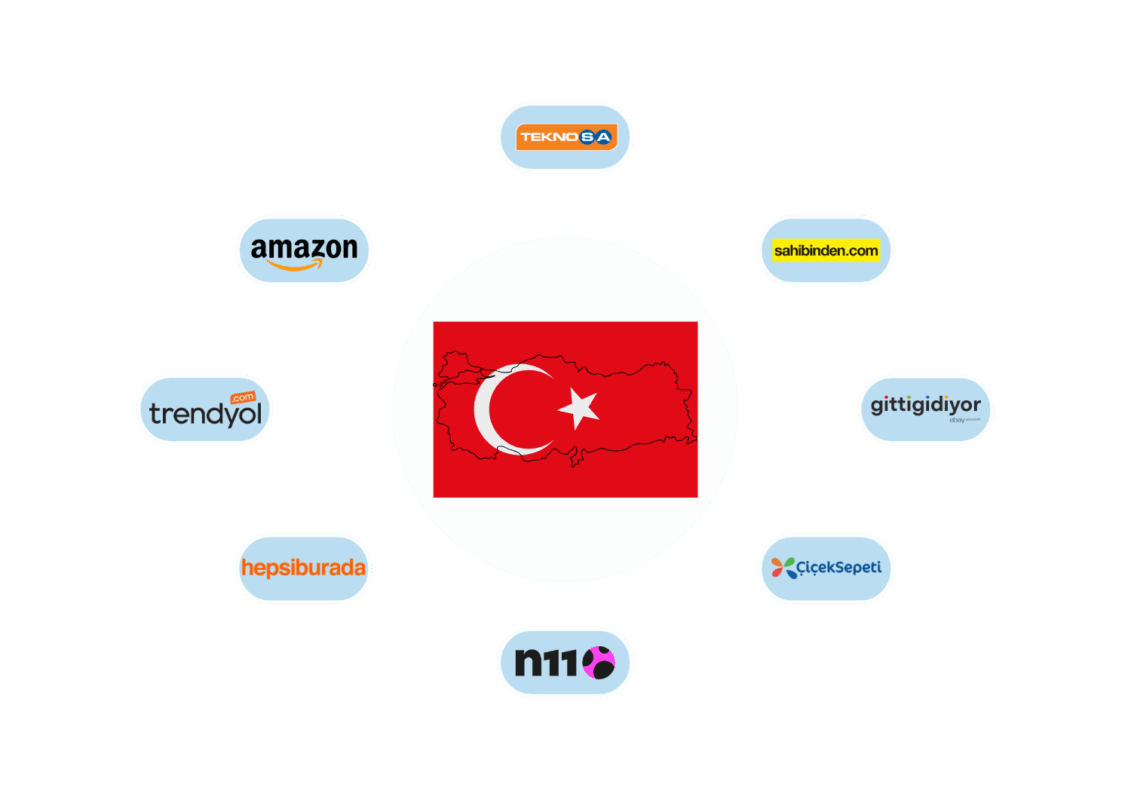
Türkiye sits at the crossroads of Europe, Asia and the Middle East, and its e-commerce market reflects that unique position; fast-moving, mobile-first and growing at a pace that consistently outperforms most of its European neighbours. According to ECDB, the Turkish e-commerce market generated US$42 billion in revenue in 2024, with projections pointing to a further 10–15% increase in 2025. Online marketplaces sit at the heart of this boom, with the top five platforms holding roughly 60% of combined market share (Mordor Intelligence). For international sellers and brands seeking access to over 85 million consumers, understanding which Turkish marketplaces to prioritise in 2026 is a strategic imperative.


The Turkish e-commerce market at a glance

  • Market scale: Turkey’s e-commerce market reached US$42 billion in 2024, with monthly revenues in November 2025 alone reaching US$5.4 billion – a 15–20% surge month-on-month (ECDB).
  • Mobile-first nation: 91% of all e-commerce transactions in Turkey are completed via mobile device (Ecommerce News EU), making app quality and mobile UX a decisive factor in marketplace selection for sellers.
  • Young, digital consumer base: Half of Turkey’s population is under 30 years old (among the youngest demographics in the wider European region) driving high digital adoption, social commerce engagement and strong demand for fast, mobile-native shopping experiences.
  • Electronics and fashion dominate: Electronics accounts for 41% of total Turkish e-commerce revenue, followed by fashion and apparel at 25%, the two combined categories represent the majority of marketplace volume (ECDB).
  • Strategic position: Turkey’s EU Customs Union, extensive logistics infrastructure and position bridging European and MENA markets make it a compelling cross-border gateway. Trendyol’s logistics hub near Bucharest already supports next-day delivery across the Balkans, while new regulations incentivise Turkish exporters via the e-İhracat (e-export) tax rebate programme.


Top Turkish marketplaces in 2026

1) Trendyol

Trendyol is Turkey’s dominant marketplace and the undisputed leader of Turkish e-commerce, holding an estimated 34–40% of total market share. Founded in 2010 and acquired by Alibaba Group in 2018, Trendyol generated US$12.5 billion in GMV in 2024 (a 30–35% year-on-year increase) with projections indicating a further 10–15% rise in 2025 (ECDB). Fashion accounts for 31% of its total sales, followed by electronics, furniture and homeware. Trendyol also operates its own logistics arm (Trendyol Express), a fast-grocery delivery service (Trendyol Go), and a payment platform – making it a full ecosystem rather than a simple marketplace. International expansion is accelerating rapidly: international revenue now represents nearly 20% of total business, with strong traction in the Gulf region where Trendyol has already surpassed $1 billion in GMV and continues to target a 50% international revenue mix before its planned IPO (The National).

  • Suits: virtually all product categories; strongest in fashion, electronics, home & living, FMCG, beauty and sports.
  • Notes: Trendyol’s mobile app is central to its strategy, sellers must ensure mobile-optimised product imagery and descriptions; Turkish-language localisation and TRY pricing are required; same-day delivery is available in major Turkish cities via Trendyol Express.


2) Hepsiburada

Often called “the Amazon of Turkey,” Hepsiburada is Turkey’s second-largest marketplace and the only Turkish e-commerce platform listed on NASDAQ (ticker: HEPS). Founded in 2000, the platform underwent a landmark ownership change in January 2025 when Kazakhstan-based digital ecosystem Kaspi.kz acquired a 65.4% controlling stake for US$1.127 billion, bringing integrated payments and buy-now-pay-later (BNPL) capabilities to the platform. In Q3 2025, Hepsiburada reported GMV growth of 8.9%, revenue growth of 22.1%, and order growth of 17.6% year-on-year, with its active merchant base reaching 101,300 sellers (Hepsiburada Q3 2025). The marketplace GMV share stands at 69.2%, confirming that third-party sellers now drive the majority of its volume. Its fintech arm Hepsipay and logistics network HepsiJet (which handles 72% of all platform parcels) give the ecosystem a strong end-to-end infrastructure.

  • Suits: electronics, home appliances, fashion, garden, sports and FMCG; the platform’s Hepsiburada Premium loyalty programme (3.7 million members by end 2024) drives strong repeat purchase in key categories.
  • Notes: Hepsiburada’s NASDAQ listing requires it to meet international financial reporting standards, a signal of governance maturity that can reassure international sellers; Hepsipay’s BNPL tools help consumers in a high-inflation environment manage large purchases, boosting electronics and home appliance conversion rates.


3) Amazon Turkey (Amazon.com.tr)

Amazon launched its dedicated Turkish marketplace in 2018 and has steadily built a position as the third-largest e-commerce platform in Turkey, capturing an estimated 6% market share (AVASK). According to ECDB, Amazon Turkey generated US$443.8 million in net sales in a recent annual period, ranking fourth in the country’s overall online store rankings. Amazon’s main structural advantage in Turkey is as an international gateway: sellers already operating on Amazon.de, Amazon.fr or Amazon.co.uk can add Amazon.com.tr with minimal friction using the same seller account infrastructure, enabling them to tap Turkish consumer demand without a fully localised market entry strategy.

  • Suits: electronics, books, fashion, home goods and international brands looking for a low-friction entry point into the Turkish market.
  • Notes: Amazon Prime has a growing subscriber base in Turkey; VAT compliance at the standard Turkish rate of 20% (most products) is mandatory; Turkish-language product listings significantly improve conversion rates compared to translated listings.

Connect via Lengow: Sell on Amazon with Lengow.


4) n11

n11 is one of Turkey’s pioneer marketplaces, founded in 2012 and historically operating as a hybrid B2C/C2C platform with a strong electronics and general merchandise offering. Carrying an estimated 10–12% market share (AVASK), n11 underwent a significant ownership change in May 2025 when UAE-based DMSF Holding completed its acquisition of the platform (CB Insights), signalling renewed investment and potential regional expansion ambitions. The platform is particularly strong in electronics and home goods, and its loyalty programmes and frequent promotional campaigns (including seasonal flash sales) maintain a loyal returning customer base. For sellers, n11 remains a relevant second or third marketplace destination that complements a Trendyol-first strategy.

  • Suits: electronics, home appliances, fashion, cosmetics and baby products targeting Turkish consumers seeking deals and promotions.
  • Notes: new DMSF Holding ownership may bring investment and product changes; sellers should monitor platform developments through 2026; commission rates and listing fees are competitive relative to larger platforms.


5) Çiçeksepeti

Çiçeksepeti (literally “flower basket”) began life as Turkey’s leading online florist but has evolved into a full-scale gifting and lifestyle marketplace, covering electronics, home décor, toys, cosmetics, pet products and much more, alongside its original flower and plant offering. With an estimated 3–5% market share and over US$163.7 million in annual net sales (ECDB), Çiçeksepeti’s unique strength lies in its deeply emotional purchase occasions (birthdays, Valentine’s Day, Mother’s Day and Eid) making it one of Turkey’s highest-converting platforms for gift-suitable products. Its strong seasonal campaign cadence drives significant spikes in traffic and conversion, and its loyal customer base skews female and urban.

  • Suits: gifts, flowers, plants, home décor, toys, cosmetics, personal care, electronics accessories and lifestyle products.
  • Notes: sellers with visually appealing, gift-appropriate products benefit disproportionately from Çiçeksepeti’s seasonal campaigns; pairing product listings with gift messaging options and attractive packaging drives above-average conversion.


6) GittiGidiyor

GittiGidiyor is eBay’s Turkish marketplace, launched in 2001 and acquired by eBay in 2011. As one of Turkey’s oldest online selling platforms, it holds significant brand recognition – particularly for second-hand goods, collectibles, fashion and electronics – and attracts an estimated 50 million monthly visitors. Its C2C model makes it the destination of choice for Turkish consumers looking to buy and sell pre-owned items, placing it at the heart of Turkey’s growing recommerce culture. For international sellers already selling on eBay’s global network, GittiGidiyor provides a natural extension with a familiar back-end and a well-established Turkish buyer base.

  • Suits: second-hand and pre-owned goods, fashion, collectibles, electronics, automotive parts and artisanal products targeting Turkish consumers open to C2C and recommerce purchasing.
  • Notes: eBay’s global seller infrastructure simplifies cross-border listing management; Turkish-language content is important for maximising discoverability on the platform; GittiGidiyor’s C2C roots mean pricing expectations can be highly competitive.


7) Sahibinden.com

Sahibinden.com is Turkey’s dominant classified ads and C2C marketplace, occupying a distinct niche from pure-play product marketplaces. It is the go-to platform for Turks buying and selling real estate, vehicles, electronics and second-hand goods through direct peer-to-peer listings. Its model is closer to LeBonCoin in France or OLX in Eastern Europe than a traditional B2C marketplace, but it attracts tens of millions of monthly visits and represents a critical channel for sellers of used vehicles, property and consumer durables. Increasingly, professional merchants are also using Sahibinden to list new inventory alongside private individuals.

  • Suits: real estate, vehicles, used electronics, furniture, second-hand fashion and consumer durables – ideally suited for both private sellers and professionals targeting Turkish consumers in a C2C-native environment.
  • Notes: listing management differs from traditional marketplace seller portals; Sahibinden requires direct communication between buyers and sellers, making Turkish-language responsiveness a key success factor for professional merchants.


8) Teknosa

Teknosa is Turkey’s leading specialist electronics retailer, operating both a nationwide brick-and-mortar chain and a growing online marketplace platform. With deep consumer trust built over decades in the Turkish tech retail space, Teknosa’s online platform is a key destination for consumers seeking electronics, home appliances, personal tech and digital accessories from verified sellers backed by strong after-sales service. Its omnichannel model – combining online listings with in-store collection and support – resonates strongly with Turkish consumers who value the reassurance of physical retail when buying high-ticket electronics.

  • Suits: consumer electronics, home appliances, personal tech, gaming, photography and accessories, particularly strong for brands able to offer post-sale support aligned with Teknosa’s service-first positioning.
  • Notes: Teknosa’s curated marketplace model means seller onboarding is more selective; demonstrating brand reliability, local warranty coverage and Turkish regulatory compliance (CE marking, e-waste compliance) are key requirements.


Who should sell where in Turkey?

  • Maximum reach (all categories): Trendyol, Hepsiburada.
  • International gateway (low friction): Amazon Turkey.
  • Electronics specialist: Teknosa, Hepsiburada, n11.
  • Fashion and apparel: Trendyol, GittiGidiyor.
  • Gifts, flowers and lifestyle: Çiçeksepeti.
  • Second-hand and recommerce: GittiGidiyor, Sahibinden.com.
  • Deals and promotions-driven buyers: n11.
  • Real estate and vehicles: Sahibinden.com.


Key considerations for selling on Turkish marketplaces

Entering the Turkish e-commerce market requires sellers to think carefully about several market-specific factors. Currency and inflation play a significant role: Turkey has been operating under IAS 29 hyperinflationary accounting rules since 2022, and the Turkish Lira (TRY) has experienced significant volatility; sellers should build currency hedging into their pricing strategy and monitor exchange rates closely.

On the payments front, instalment payment options (taksit) are deeply embedded in Turkish consumer culture, particularly for electronics and high-ticket items; platforms like Hepsiburada (via Hepsipay) and Trendyol offer built-in BNPL solutions that significantly improve conversion rates. In terms of logistics, Turkey has excellent domestic infrastructure with major carriers including Yurtiçi Kargo and Aras Kargo, and all leading marketplaces offer fulfilment services for third-party sellers.

Finally, Turkish-language product data – including category-specific attributes, precise technical specifications and authentic product imagery – is non-negotiable for achieving strong search visibility and conversion on any Turkish marketplace.

3,600+ brands & distributors grow with us