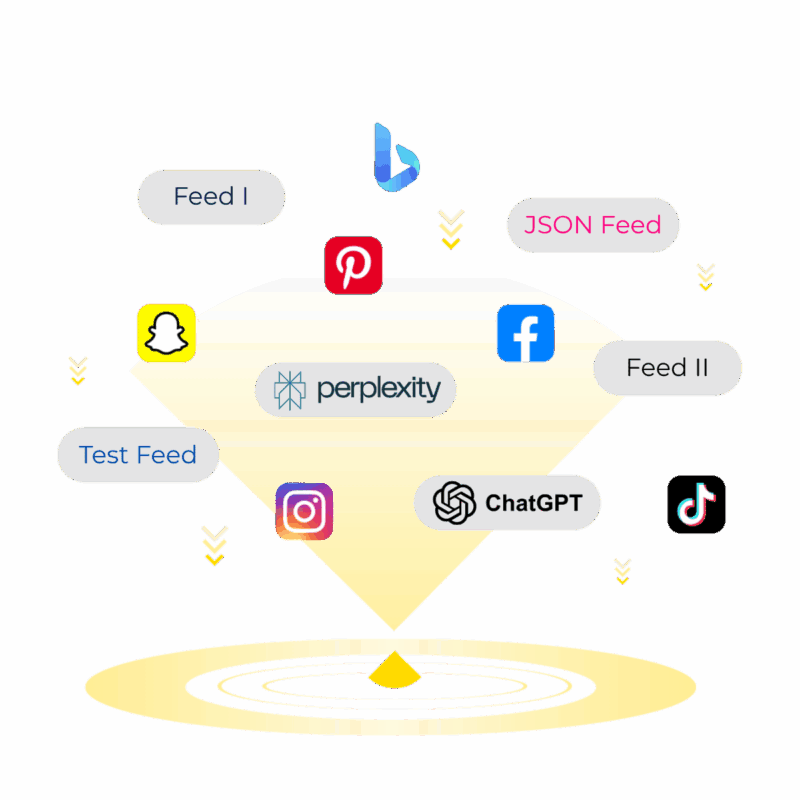
More than 700 million people use ChatGPT every week to ask questions, get recommendations and increasingly, to find and buy products. When a user types “help me find a vegan handbag under €200” or “I need a running stroller for city sidewalks”, ChatGPT can now show rich shopping results with images, specs and direct purchase options, without sending them to a traditional search engine.

For brands and retailers selling online, the question is simple: how do we become the products ChatGPT recommends? The answer lies in two pillars:

  • A clean, structured product feed that follows OpenAI’s Product Feed Specification, so your catalog can be indexed and surfaced in ChatGPT Shopping.
  • A strong AI-ready product data foundation (titles, attributes, reviews, policies) orchestrated across all your channels, which is exactly what Lengow is built to manage.

This page walks you through how ChatGPT Shopping works, what brands and retailers need to do in practice, and how to use Lengow to appear as a brand in ChatGPT’s answers and shopping experiences.


How ChatGPT Shopping works for brands & retailers

ChatGPT Shopping is powered by OpenAI’s Product Feed and the Agentic Commerce Protocol (ACP). Instead of crawling your products from the web, ChatGPT expects a merchant-controlled feed with structured data.

  • Product Feed: you send a structured file (CSV, TSV, XML or JSON) with core fields like id, title, description, price, availability, image_link, brand, logistics and policy data. This becomes the single source of truth ChatGPT uses for search and recommendations.
  • Shopping results: when ChatGPT detects shopping intent, it shows product options with imagery, details and links. These results are not ads and are not influenced by partner payments; they are chosen independently by the model.
  • Instant Checkout: with ACP, users in supported regions can complete purchases directly inside ChatGPT. OpenAI and Stripe developed ACP as an open standard so agents can show catalogues, initiate checkout and delegate payment securely.
  • Merchant control: you decide which products are eligible for search and checkout, and you remain merchant of record. Policies, brand name, prices and stock are all fed directly by you.

Lengow integrates with this ecosystem by supporting the OpenAI Product Feed out-of-the-box, allowing merchants to plug their catalog into ChatGPT with minimal custom development.


What appearing “as a brand in ChatGPT” actually means

For brands and retailers, visibility in ChatGPT happens on several layers:

  • Product cards in ChatGPT Shopping: your SKUs appear with images, price and short descriptions when users search with clear shopping intent (“best moisturiser for oily skin”, “office chair under €300”).
  • Brand and category recommendations: ChatGPT might suggest your brand as part of an answer (“Brands like X and Y offer…”), drawing on your site content, feeds, and marketplace presence.
  • Agentic journeys with Instant Checkout: the assistant refines options with the user, then completes purchase via ACP, using your feed and checkout endpoints.

To consistently appear here, you need two things: excellent product data and a fully compliant Product Feed plugged into OpenAI’s commerce stack.


Step 1 – Get your product data AI-ready

Before you even touch the OpenAI Product Feed, make sure your catalog is ready for AI search and agentic journeys.

Standardise and enrich your catalog

  • Centralise your data: use Lengow’s product feed management to pull data from your ecommerce platform, PIM and ERP into a single, enriched catalog that you can then distribute to all channels, including ChatGPT.
  • Fill every critical field: ensure every SKU has titles, brand, category, GTIN/UPC/MPN, price, availability, key attributes (size, colour, material, age group, compatibility) and at least one high-quality image.
  • Use machine-friendly values: instead of vague terms (“very comfy”), use testable attributes (“100% cotton”, “support up to 120kg”, “noise level 40dB”). This helps ChatGPT reason about your products.

Write for real shopper intent

  • Enrich product descriptions with use cases and constraints: “ideal for small apartments”, “vegan leather, PVC-free”, “for sensitive, acne-prone skin”. This matches the natural language users type into ChatGPT.
  • Keep copy factual and concise. ChatGPT favours clear, comparable details over marketing fluff, especially for product comparisons.
  • Make generous use of bullets and short paragraphs; LLMs parse structured lists very well when constructing answers.

Leverage reviews and policies

  • Expose ratings and review counts in your data (on-site and in feeds) so ChatGPT can highlight social proof (“4.7★, 320 reviews”).
  • Publish and maintain clear return, shipping and privacy policies – these are required fields in the Product Feed and critical in AI-driven purchase decisions.


Step 2 – Build your ChatGPT Product Feed

Once your catalog is clean, you can translate it into OpenAI’s Product Feed format. Think of this as speaking ChatGPT’s native language for products.

Understand the Product Feed Specification

  • Review the official Product Feed Spec: it lists required and recommended fields, formats, and validation rules for ChatGPT Shopping.
  • Note key attributes such as id, title, description, link, image_link, price, availability, inventory_quantity, brand, condition and flags like enable_search and enable_checkout.
  • Plan how you’ll send the feed (CSV, TSV, XML or JSON) and how often you’ll update it – frequent refreshes keep ChatGPT aligned with your real stock and prices.

Use Lengow to map your catalog to the spec

  • Map fields once: in Lengow, map your internal attributes to OpenAI’s fields (e.g. your “Main Image URL” → image_link; “Stock” → inventory_quantity). Lengow’s UI and rules make this mapping easier to maintain over time.
  • Generate compliant values: use transformation rules to convert localised or free-text values into the formats required by the spec (e.g. currencies, availability enums like in_stock, preorder).
  • Validate before sending: Lengow can help you detect missing mandatory fields, invalid URLs and format errors, reducing back-and-forth with OpenAI.


Step 3 – Prepare for Instant Checkout with ACP

If you want shoppers to buy directly inside ChatGPT (available only in selected countries), not just click out to your site, you’ll need to implement ACP-compatible checkout endpoints.

  • Read the Agentic Commerce guides and Checkout Spec to understand how ChatGPT creates and updates checkout sessions.
  • Work with your PSP (Stripe, PayPal and others that adopt ACP) to handle delegated payments securely while keeping you as merchant of record.
  • Coordinate with your dev and ecommerce teams so inventory, pricing and order status flows back into your existing systems.

You can start with enable_search=true and enable_checkout=false to appear in ChatGPT’s product search first, then move to full Instant Checkout once your ACP integration is ready.


Step 4 – Connect via Lengow and go live

Lengow’s ChatGPT Shopping support lets you treat ChatGPT like any other high-value channel.

  • Activate ChatGPT Shopping in Lengow: follow Lengow’s dedicated guides for the OpenAI Product Feed; most merchants can reuse existing mappings from Google Shopping or marketplaces as a starting point.
  • Schedule frequent updates: set exports to run as often as your operations allow (e.g. every 15–30 minutes for price/stock-sensitive categories). ChatGPT relies on your feed for accuracy.
  • Use rules to protect margins: with Lengow, you can exclude low-margin SKUs, enforce minimum prices, or prioritise specific hero products in each category.


Step 5 – Optimise for ChatGPT queries and measure impact

Once you’re live, treat ChatGPT like a new, high-intent acquisition channel that deserves its own optimisation loop.

  • Test prompts regularly: in ChatGPT, run realistic queries (“best X for Y”, “under €Z”, “eco-friendly”, “for sensitive skin”) for your categories and see whether your products appear and how they’re described.
  • Refine attributes and copy: if ChatGPT struggles to differentiate your products, add clearer attributes (material, use case, compatibility) and more precise descriptions in your Lengow catalog and feed.
  • Monitor performance: track clicks, assisted conversions and revenue from ChatGPT Shopping in your analytics stack; combine this with AI visibility tools that measure your share of product recommendations across categories.


How Lengow helps brands appear (and win) in ChatGPT

ChatGPT Shopping rewards brands and retailers with clean, consistent and richly structured product data. Lengow gives you the operational backbone to deliver exactly that, without hiring a dedicated AI team.

  • One canonical product feed: centralise, standardise and enrich your catalog once, then reuse it for marketplaces, ads and ChatGPT Shopping.
  • Channel-specific optimisation: adapt titles, attributes and policies to ChatGPT’s Product Feed while staying aligned with Google Shopping and marketplaces – all from the same interface.
  • Automation & quality control: automate updates, fix feed errors early and keep prices and stock in sync, so ChatGPT doesn’t show unavailable items or outdated offers.
  • Future-proof AI commerce: as ACP and AI shopping roll out to more agents and regions, your Lengow-powered feeds can be reused to connect with new AI channels quickly.

By combining best-in-class product data with the OpenAI Product Feed via Lengow, you give ChatGPT everything it needs to understand, trust and recommend your catalog. As shoppers move from search engines to conversations, that’s how your brand keeps showing up.


Quick checklist: appear as a brand in ChatGPT

  • ✅ Clean and enrich your catalog (titles, attributes, images, reviews, policies) in a centralised system like Lengow.
  • ✅ Review the OpenAI Product Feed Specification and map your data to required and recommended fields.
  • ✅ Activate and maintain a compliant Product Feed to ChatGPT Shopping via Lengow.
  • ✅ Plan your ACP/Instant Checkout roadmap to enable in-chat purchases when you’re ready.
  • ✅ Test real prompts in ChatGPT, refine your data, and monitor performance as you would any key acquisition channel.

3,600+ brands & distributors grow with us