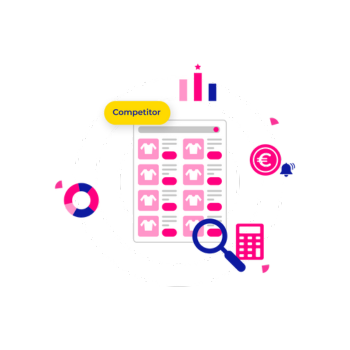
To compare the price of a specific SKU against identical competitor offers, you first need to accurately identify matching products across the market and then monitor their prices, availability and positioning. This enables brands and retailers to understand whether they are priced above, below or in line with competitors while protecting margins and improving competitiveness.

  • Automatically identify identical products across competitor catalogues
  • Compare prices by SKU, channel, country or retailer
  • Track price and stock changes over time
  • Analyse your competitive pricing position with dedicated dashboards
  • Implement data-driven repricing strategies when needed


Why comparing a specific SKU is important

In today’s competitive ecommerce landscape, the same product can be sold by multiple retailers across DTC websites, marketplaces and comparison shopping engines. Without visibility into competitor pricing, it becomes difficult to know whether your offer remains attractive to customers.

For any specific SKU, ecommerce teams need answers to key questions:

  • Which competitors are selling the exact same product?
  • What prices are they offering?
  • Are competitors currently in stock?
  • Is my price above, below or aligned with the market?
  • Should I adjust pricing to remain competitive while protecting margins?

Without a dedicated pricing intelligence solution, obtaining these insights often requires time-consuming manual research that becomes impossible to scale.


How to compare a SKU with identical competitor offers

1. Identify the SKU you want to analyse

The first step is selecting the product you want to monitor. This could be a best-selling item, a highly competitive product, a strategic SKU or a product experiencing declining sales performance.

Products can be identified using:

  • Internal SKU references
  • EAN or GTIN codes
  • Product titles
  • Brand names
  • Categories
  • Sales channels


2. Find identical products across competitor catalogues

Accurate price comparison is only valuable when the products being compared are truly identical.

This is where product matching becomes critical.

With NetRivals, AI-powered product matching automatically identifies identical products across competitor catalogues.

This allows retailers and brands to compare the right products, even when competitors use:

  • Different product titles
  • Alternative descriptions
  • Different product images
  • Unique catalogue structures
  • Channel-specific merchandising strategies

By automating product matching, businesses gain reliable competitive intelligence at scale.


3. Monitor competitor pricing across all channels

Once matching products have been identified, the next step is monitoring competitor pricing wherever they sell.

NetRivals tracks competitors across:

  • Direct-to-consumer ecommerce websites
  • Multi-seller marketplaces
  • Comparison shopping engines
  • Public online catalogues
  • International markets and currencies

This creates a comprehensive view of your SKU’s competitive position across the digital shelf.


Which metrics should you analyse?

A strong pricing analysis goes beyond simply comparing displayed prices.

For each SKU, businesses should monitor:

  • Lowest market price: identify the most aggressive competitor
  • Average market price: understand overall market positioning
  • Price gap: measure the difference between your price and competitors
  • Stock availability: determine whether competitor prices are actionable
  • Historical pricing trends: track pricing movements over time
  • Channel performance: compare pricing dynamics across different sales channels

These insights help businesses make informed pricing decisions rather than reacting blindly to market changes.


Example: analysing a specific SKU against competitors

Imagine an electronics retailer selling a product for €249.

Using competitive price intelligence, they discover:

  • Two competitors are selling the same product for €239
  • One competitor lists the product at €229 but is currently out of stock
  • The average market price is €242
  • The product continues to perform well despite being priced above average

In this situation, immediately lowering the price to €229 may not be the best strategy.

Instead, the retailer can:

  • Align with competitors that are actively in stock
  • Maintain pricing if sales performance remains strong
  • Create channel-specific pricing rules
  • Protect margins when competitive pressure is limited

This approach balances competitiveness with profitability.


How NetRivals helps compare SKU prices against competitors

NetRivals provides brands and retailers with the competitive intelligence needed to analyse pricing accurately and react strategically.

With NetRivals, ecommerce teams can:

  • Monitor competitor prices across DTC sites, marketplaces and comparison shopping engines
  • Automatically identify identical products with AI-powered product matching
  • Track prices, stock levels, images and public competitor content
  • Receive daily updated market intelligence
  • Segment products by category, brand, geography, channel or custom tags
  • Visualise competitive positioning through ready-to-use dashboards
  • Build pricing strategies without coding
  • Automate multi-channel repricing to stay competitive while protecting margins


Turn competitive price data into action

Comparing prices is only the beginning. The real value comes from using pricing intelligence to make better commercial decisions.

With NetRivals, businesses can:

  • Identify products where pricing negatively impacts conversion
  • Detect opportunities to increase margins
  • Spot aggressive competitors quickly
  • Adjust pricing by channel, geography or product category
  • Support marketplace and DTC growth strategies with real market data

Instead of relying on assumptions, teams can make pricing decisions based on real competitive insights.


Conclusion

Comparing the price of a specific SKU against identical competitor offers requires accurate product matching, reliable market data and continuous competitor monitoring. By automating these processes, businesses gain a clear understanding of their competitive position and can optimise pricing strategies more effectively.

NetRivals helps brands and retailers monitor competitors, analyse market trends, implement smarter pricing strategies and protect profitability while remaining competitive.

Request a demo

FAQ – NetRivals

How can I find identical products in competitor catalogues?

Finding identical products manually is difficult because competitors often use different product titles, descriptions and catalogue structures. Competitive intelligence solutions like NetRivals use AI-powered product matching to automatically identify identical products across competitor websites, marketplaces and comparison shopping engines, ensuring accurate price comparisons.

Should I always match the lowest competitor price?

Not necessarily. The lowest price is only one factor in a pricing strategy. Businesses should also consider stock availability, product demand, margins, sales performance and channel-specific dynamics. A competitor may offer the lowest price but be out of stock, making aggressive repricing unnecessary. The goal is to remain competitive while protecting profitability.

What is the difference between competitor price monitoring and dynamic repricing?

Competitor price monitoring provides visibility into how your prices compare with the market. Dynamic repricing takes this a step further by automatically adjusting prices according to predefined rules and market conditions. NetRivals combines both capabilities, allowing businesses to monitor competitors and automate pricing decisions when appropriate.

3,600+ brands & distributors grow with us