Africa is one of the world’s fastest-growing e-commerce regions and one of its most underestimated. The continent’s e-commerce market is projected to reach US$40.5 billion in revenue in 2025, growing at a CAGR of 8.46% through 2029 toward a projected US$56 billion by 2029 (Statista, 2025). With over 60% of e-commerce transactions conducted on mobile devices, a youthful population of 1.4 billion, and rapid smartphone and internet penetration across Sub-Saharan Africa, North Africa and the Gulf, the opportunity for international brands is real and growing fast.

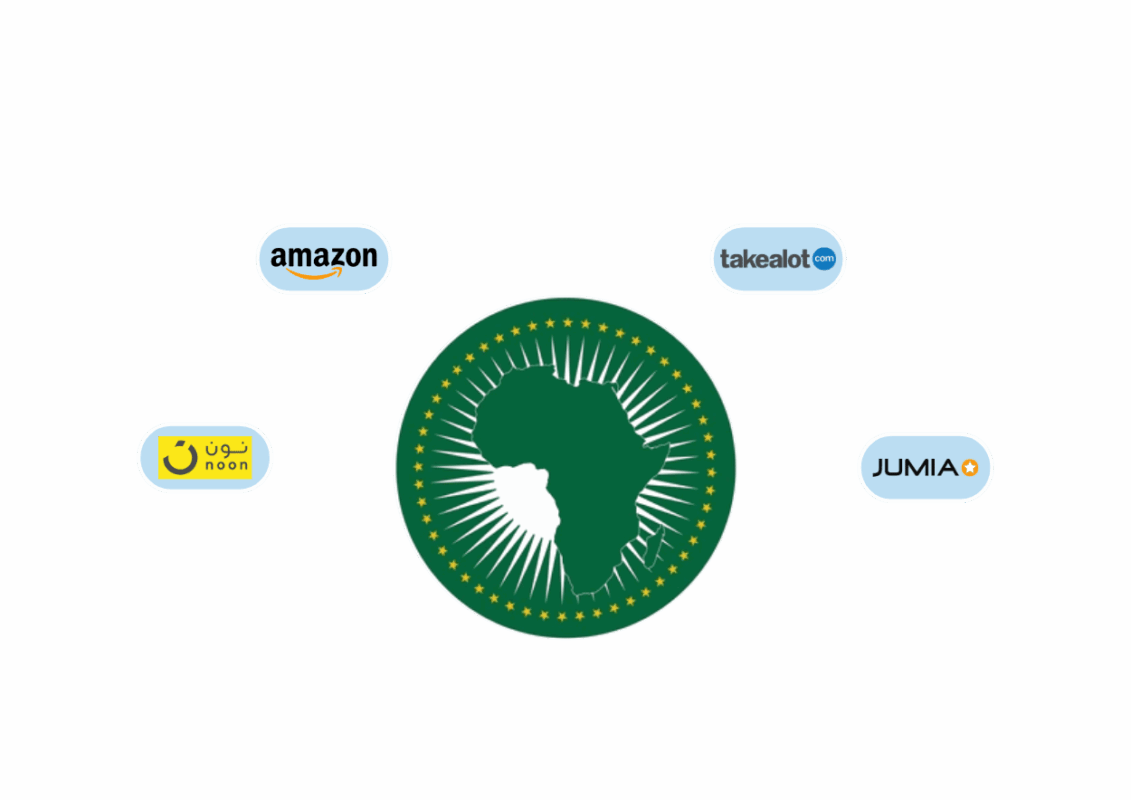
The African e-commerce landscape is also evolving rapidly. Amazon launched in South Africa in May 2024, recruiting over 10,000 sellers in its first year and reshaping competitive dynamics across the continent’s most mature digital market. Global platforms like Temu and Shein are capturing share in fashion. And pan-African players like Jumia and Takealot are doubling down on logistics infrastructure to meet rising consumer expectations. According to the ECDB 2025 global retailer ranking, Amazon, Takealot and Jumia are the leading platforms for online retail in Africa by GMV – followed by SHEIN, Temu and Noon. This article covers the key African marketplaces for brands and retailers looking to enter or expand on the continent in 2026.


Africa at a glance

  • Market size: Africa’s e-commerce market projected at US$40.5 billion in 2025, growing to US$56 billion by 2029 at 8.46% CAGR (Statista).
  • Mobile-first continent: over 60% of e-commerce transactions completed on mobile devices in 2025; smartphone adoption projected to reach 623 million unique subscribers by 2025 (TechCabal Insights).
  • Key markets: Nigeria leads with 26% of Africa’s e-commerce revenue; South Africa is the most mature and structured market; Egypt, Kenya and Morocco are fast-growing secondary markets (Market Data Forecast, 2026).
  • Top categories: apparel and electronics lead online sales across the continent; healthcare is the fastest-growing category at 22.4% CAGR through 2033.
  • Payments landscape: mobile money is critical – M-Pesa (Kenya), OPay (Nigeria) and MTN MoMo dominate in Sub-Saharan Africa. Cash-on-delivery remains significant in many markets. Instant payment transaction volumes exceeded 64 billion in 2024 (Africa B2C E-Commerce & Payments Report 2026).
  • Global players moving in fast: Amazon South Africa launched May 2024; Temu and Shein together captured 37% of South Africa’s online clothing market in 2024 (Mordor Intelligence).


Top African marketplaces in 2026

1) Amazon South Africa (Amazon.co.za)

Amazon launched its South African marketplace in May 2024 – its first dedicated storefront in Sub-Saharan Africa – and immediately became a major competitive force. In its first year, Amazon recruited over 10,000 sellers in South Africa (Mordor Intelligence), offering a ZAR 1 monthly promotional fee to attract micro-merchants and broadening category depth rapidly.

South Africa’s e-commerce market stands at US$35.23 billion in 2024, growing to a projected US$74.79 billion by 2033 at an 8.79% CAGR (Yahoo Finance / IMARC Group). South Africa is the continent’s most digitally mature market – 74.7% of South Africans had internet access as of January 2024 – with advanced payment infrastructure, reliable logistics operators and a consumer base accustomed to home delivery.

  • Suits: electronics, home goods, fashion, sports, beauty and consumer tech. All product categories available on Amazon’s global marketplace infrastructure are accessible on Amazon.co.za.
  • Notes: South African VAT registration (15%) required for sellers exceeding local thresholds. Rand (ZAR) pricing is mandatory. South African English product listings perform best. Pan-European FBA does not cover South Africa, sellers need a local fulfilment strategy or an Amazon South Africa–specific logistics partner.

Connect via Lengow: Sell on Amazon South Africa with Lengow.


2) Takealot

Takealot is South Africa’s largest and most established domestic marketplace, founded in 2011 and now majority-owned by Naspers. It reached a 31.9% usage rate among South African online shoppers in 2024 (Mordor Intelligence) – making it the most visited domestic e-commerce destination – and generated US$1.483 billion in GMV in 2025, ranking it first in Africa by GMV in the ECDB global retailer ranking. Following a 2023 Competition Commission ruling, Takealot now operates separate retail and marketplace arms, a structural change that has levelled the playing field for third-party merchants selling alongside Takealot’s own inventory.

Takealot is actively expanding into underserved markets by deploying personal shoppers in townships and rural areas, broadening its consumer base well beyond South Africa’s urban core.

  • Suits: electronics, home appliances, fashion, beauty, sports and general merchandise targeting South African consumers. Strong brand recognition across all demographic and income segments.
  • Notes: Takealot does not integrate via Lengow at this time. Sellers onboard directly via the Takealot Marketplace Seller Portal. South African entities or registered VAT vendors preferred; logistics via Takealot’s own network (TNT, RAM, CourierGuy) or seller-managed.


3) Jumia

Jumia is the pan-African e-commerce platform with the broadest geographic reach on the continent, operating in 11 countries across West Africa (Nigeria, Côte d’Ivoire, Senegal, Ghana), East Africa (Kenya, Uganda, Tanzania) and North Africa (Morocco, Egypt, Algeria, Tunisia). Founded in Lagos in 2012 and NASDAQ-listed since 2019, Jumia generated US$641.9 million in GMV in 2024 (Jumia 2024 Annual Report) and reported a 34% revenue surge in Q4 2025, advancing toward Adjusted EBITDA breakeven by late 2026 (IMARC Group, February 2026). In October 2024, Jumia exited South Africa and Tunisia to concentrate resources on faster-growing West and East African markets.

For any brand seeking multi-country African reach in a single integration, Jumia remains the only platform offering that breadth today, covering markets from Lagos to Nairobi under one seller account.

  • Suits: electronics, fashion, beauty, home goods and FMCG targeting consumers in Nigeria, Kenya, Egypt, Morocco and across West and East Africa. Particularly strong in Nigeria (#1 African e-commerce market by revenue share at 26%) and Kenya.
  • Notes: Jumia does not currently integrate via Lengow. Onboarding is managed directly via Jumia’s Seller Centre, with separate logistics handled through Jumia Logistics. Mobile-first product listings and local-language content (French for West Africa, Arabic for North Africa) improve conversion significantly.


4) Noon

Noon is a UAE-founded marketplace with a growing presence in North Africa, particularly Egypt – one of Africa’s most significant e-commerce markets with a population of 107 million and a rapidly digitising consumer base. Founded in 2017 and backed by the Saudi Public Investment Fund and Mohamed Alabbar, Noon operates across Saudi Arabia, UAE, Egypt and Kuwait, generating US$223 million in GMV in Africa (primarily Egypt) in 2025 per the ECDB global retailer ranking. Noon’s Egyptian operation benefits from its regional logistics infrastructure and its positioning as a premium alternative to global giants in the MENA-Africa corridor.

Egypt is projected to become one of Africa’s top three e-commerce markets through 2030, driven by a young, increasingly online population and a growing fintech ecosystem. For international brands already selling in the Gulf via Noon, the Egyptian extension is a natural next step.

  • Suits: electronics, fashion, beauty, home goods and sports targeting Egyptian consumers and the wider MENA-Africa corridor. Particularly relevant for brands already present in Saudi Arabia or UAE.
  • Notes: Noon does not currently integrate via Lengow. Arabic-language product listings and EGP pricing are essential for the Egyptian market. Noon’s payment infrastructure supports credit cards, cash on delivery and local digital wallets.


Who should sell where in Africa?

  • South Africa (most mature market): Amazon.co.za and Takealot — the two dominant platforms, now competing directly. Amazon is accessible via Lengow.
  • Multi-country West and East Africa: Jumia — the only platform covering Nigeria, Kenya, Ghana, Côte d’Ivoire, Egypt and more under one seller account.
  • North Africa / Egypt: Jumia Egypt and Noon — complementary platforms for the Arab-speaking North African consumer.
  • International brands entering Africa for the first time: Amazon South Africa — the lowest-friction entry point, with familiar infrastructure and a proven seller onboarding process.


Key considerations for selling in Africa

Africa is not a single market; it is 54 countries with distinct languages, currencies, payment preferences, regulatory frameworks, and logistics maturity levels. Any entry strategy must be market-specific.

Payments vary enormously: mobile money (M-Pesa, OPay, MTN MoMo) is dominant in Sub-Saharan markets; card payments are more common in South Africa and North Africa; cash on delivery remains significant across most markets. Building in local payment method support is a direct conversion driver.

Logistics is the continent’s most significant structural challenge. Infrastructure gaps mean delivery times and costs vary widely outside major urban centres. Amazon and Takealot have their own logistics networks in South Africa; Jumia Logistics operates across its 11 markets. Third-party logistics providers (DHL, Kuehne+Nagel) are expanding rapidly, with Kuehne+Nagel alone operating over 35,000 sqm of fulfilment space in South Africa and 10,000 sqm in Kenya (Stattimes, 2025).

Language and localisation requirements differ by region: English for South Africa and East Africa; French for West Africa (Côte d’Ivoire, Senegal); Arabic for Egypt, Morocco, Algeria and Tunisia. Product descriptions, customer service and returns policies must be adapted accordingly.

Finally, trust and brand credibility remain critical purchase drivers across Africa, where consumer confidence in online transactions is still building. Seller ratings, clear return policies, and secure payment options are not optional — they are foundational conversion requirements.

3,600+ brands & distributors grow with us