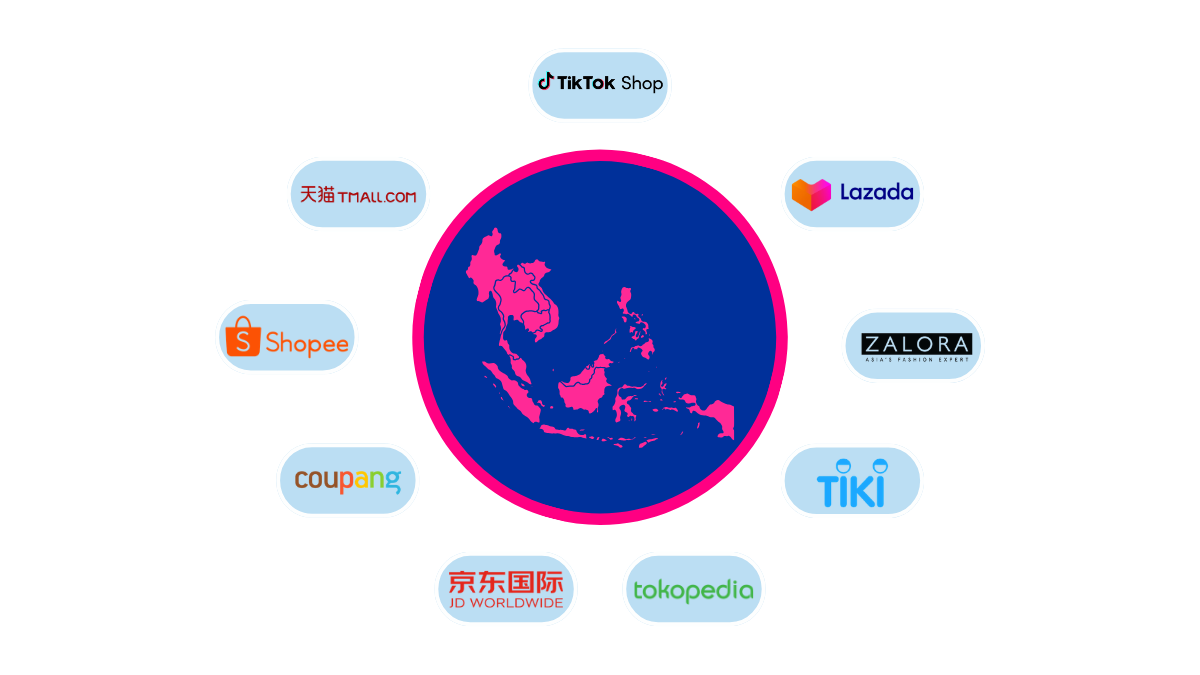
East and Southeast Asia represent the fastest-growing and most competitive e-commerce region in the world. China alone generated over US$3 trillion in e-commerce GMV in 2025, while Southeast Asia’s digital economy surpassed US$260 billion and continues to expand rapidly (Momentum Works, Google Temasek Bain SEA Report 2025). From highly mature ecosystems like China and South Korea to explosive mobile-first markets such as Indonesia, Vietnam and Thailand, the region offers enormous opportunities for international brands and retailers.

For companies looking to expand internationally in 2026, understanding which Asian marketplaces dominate consumer behaviour across East and Southeast Asia is essential.


The East & Southeast Asian e-commerce market at a glance

  • Massive regional scale: Asia-Pacific remains the world’s largest e-commerce region, accounting for more than 60% of global online retail sales in 2025 (eMarketer).
  • China leads globally: China remains the largest e-commerce market worldwide, driven by platforms such as Tmall, JD.com and Pinduoduo.
  • Mobile-first consumers: Southeast Asian shoppers overwhelmingly purchase through smartphones, with mobile commerce representing over 70% of online transactions in Indonesia, Thailand, Vietnam and the Philippines (DataReportal 2025).
  • Social commerce dominance: Livestream shopping and social commerce are central to purchasing behaviour across China and Southeast Asia, particularly through TikTok Shop, Shopee Live and LazLive.
  • Cross-border demand: Consumers across the region actively buy from international sellers, especially in beauty, fashion, electronics, luxury goods and health products.
  • Fast logistics expectations: Same-day and next-day delivery standards are becoming the norm in major urban centres including Shanghai, Seoul, Bangkok, Jakarta and Ho Chi Minh City.


Top Asian marketplaces in 2026

1) Tmall Global

Tmall Global, Alibaba Group’s cross-border marketplace, remains the leading premium B2C platform in China for international brands. The platform gives foreign companies direct access to Chinese consumers without requiring a Chinese business entity or domestic business licence.

China’s online retail market surpassed US$3 trillion in 2025, and Alibaba’s ecosystem continues to dominate premium online consumption. Tmall Global is especially influential in beauty, fashion, luxury, food, wellness and baby products, categories heavily driven by Chinese middle-class and Gen Z consumers.

The marketplace benefits from Alibaba’s wider ecosystem including Alipay, Cainiao logistics, Taobao Live and Xiaohongshu integrations, enabling sophisticated omnichannel marketing strategies.

  • Suits: premium international brands in beauty, skincare, fashion, luxury, supplements, baby products and lifestyle.
  • Notes: strong localisation is essential, including Chinese-language product pages, livestream commerce and local customer support. Brand reputation and influencer partnerships heavily impact conversion.


2) JD Worldwide

JD Worldwide is the cross-border branch of JD.com, China’s largest direct-retail and logistics-driven marketplace. Known for authenticity, premium logistics and consumer trust, JD attracts affluent Chinese consumers seeking high-quality imported goods.

JD.com generated over US$150 billion in annual net revenues in 2025 and operates one of the most advanced logistics networks globally, including automated warehouses and same-day delivery capabilities across major Chinese cities.

The platform performs particularly well in electronics, appliances, health products and premium international brands.

  • Suits: electronics, appliances, premium FMCG, sports equipment, healthcare and high-trust international brands.
  • Notes: JD consumers prioritise authenticity and delivery quality over discount positioning. Participation in key shopping festivals such as Singles’ Day (11.11) is critical.


3) Shopee

Shopee is the dominant marketplace across Southeast Asia, operating in Singapore, Indonesia, Thailand, Vietnam, Malaysia and the Philippines. Owned by Sea Limited, Shopee has become the region’s leading mobile-first commerce platform.

Indonesia alone represents Shopee’s largest market, while Thailand and Vietnam continue to experience double-digit GMV growth. The platform combines marketplace commerce with entertainment-driven shopping features including Shopee Live, gamification and integrated payments.

Shopee consistently ranks among the most downloaded shopping apps across Southeast Asia.

  • Suits: fashion, beauty, affordable electronics, home goods, accessories and fast-moving consumer products.
  • Notes: aggressive promotional campaigns and free shipping are deeply embedded in Shopee’s ecosystem. Competitive pricing and participation in mega-campaigns (9.9, 11.11, 12.12) are essential for visibility.


4) Lazada

Owned by Alibaba Group, Lazada is one of Southeast Asia’s largest regional marketplaces, operating across Indonesia, Thailand, Vietnam, Malaysia, Singapore and the Philippines.

Lazada benefits from Alibaba’s infrastructure, AI tools and logistics expertise, positioning itself as a more brand-centric marketplace compared to Shopee’s mass-market positioning.

The platform remains especially strong in electronics, appliances, beauty and official brand stores.

  • Suits: established brands, consumer electronics, beauty, appliances and official flagship stores.
  • Notes: LazMall offers enhanced visibility and trust for official brands. Strong visual merchandising and livestream commerce are increasingly important.


5) Coupang

Coupang is South Korea’s largest e-commerce marketplace and one of the most advanced logistics ecosystems globally. The platform is famous for its “Rocket Delivery” service, offering same-day and dawn delivery to millions of Korean consumers.

South Korea is among the world’s most digitally connected consumer markets, with one of the highest e-commerce penetration rates globally.

Coupang generated more than US$30 billion in net revenues in 2025 and continues expanding across retail, food delivery and streaming services.

  • Suits: beauty, electronics, premium food, fashion and fast-delivery consumer products.
  • Notes: Korean consumers have extremely high expectations regarding delivery speed, customer service and packaging quality.


6) TikTok Shop

TikTok Shop has become one of the fastest-growing social commerce platforms in Southeast Asia, particularly in Indonesia, Thailand, Vietnam and the Philippines.

Following its relaunch in Indonesia through its partnership with Tokopedia, TikTok Shop accelerated regional expansion dramatically. Livestream commerce and creator-driven selling now play a central role in Southeast Asian online shopping behaviour.

Beauty, fashion and impulse-buy categories perform exceptionally well on the platform.

  • Suits: beauty, fashion, accessories, lifestyle and highly visual consumer products.
  • Notes: success depends heavily on creator partnerships, short-form video content and livestream selling strategies.


7) Tokopedia

Tokopedia remains one of Indonesia’s largest domestic marketplaces. Indonesia is Southeast Asia’s biggest e-commerce market by population and transaction volume, with more than 280 million inhabitants and rapidly growing digital adoption.

Tokopedia has historically dominated local SME commerce and benefits from deep integration into Indonesian consumer behaviour.

Since its partnership with TikTok, Tokopedia has become even more influential in social commerce and local seller ecosystems.

  • Suits: localised consumer products, electronics, household goods, beauty and SME-focused retail.
  • Notes: Indonesian localisation is critical, including Bahasa Indonesia content, local payment methods and mobile-first optimisation.


8) Tiki

Tiki is one of Vietnam’s leading domestic e-commerce platforms and remains highly trusted for authentic products and reliable delivery.

Vietnam’s e-commerce market continues to grow at one of the fastest rates globally, fuelled by rising middle-class consumption and high smartphone penetration.

Tiki differentiates itself through quality control, fast delivery and customer trust compared to more price-driven competitors.

  • Suits: books, electronics, beauty, home goods and premium consumer products.
  • Notes: Vietnamese consumers strongly value authenticity and customer reviews. Local fulfilment partnerships improve competitiveness.


9) Zalora

Zalora is Southeast Asia’s largest fashion-focused marketplace, operating across Singapore, Indonesia, Malaysia, the Philippines and Hong Kong.

The platform specialises in fashion, beauty and lifestyle categories, positioning itself as a more premium and curated alternative to generalist marketplaces.

Zalora remains highly influential among urban millennials and Gen Z consumers across Southeast Asia.

  • Suits: fashion, footwear, beauty, accessories and lifestyle brands.
  • Notes: high-quality visuals, localised sizing and strong brand storytelling are key performance drivers.


Who should sell where in East & Southeast Asia?

  • Premium access to Chinese consumers: Tmall Global – China’s leading cross-border premium marketplace.
  • Electronics and trusted retail in China: JD Worldwide – logistics excellence and high consumer trust.
  • Mass-market Southeast Asian reach: Shopee – dominant mobile-first marketplace across SEA.
  • Brand-focused Southeast Asian expansion: Lazada – Alibaba-backed regional marketplace with strong flagship store positioning.
  • South Korean market entry: Coupang – Korea’s largest marketplace with ultra-fast logistics.
  • Social commerce and livestream selling: TikTok Shop – fastest-growing commerce channel in Southeast Asia.
  • Indonesia-focused expansion: Tokopedia – one of the country’s strongest local commerce ecosystems.
  • Vietnam-focused strategy: Tiki – trusted domestic platform with strong customer loyalty.
  • Fashion and lifestyle positioning: Zalora – Southeast Asia’s leading fashion marketplace.

3,600+ brands & distributors grow with us