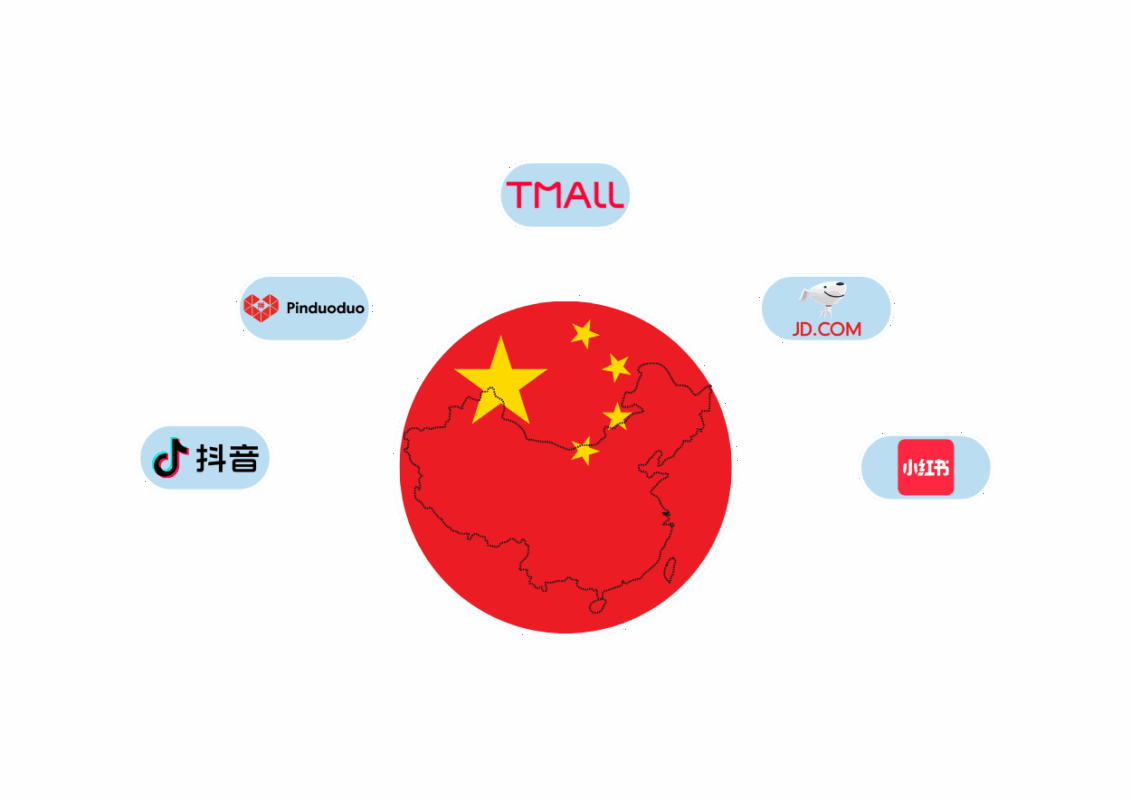
China is the world’s largest e-commerce market. With over $2.16 trillion in online retail sales in 2024, China accounts for roughly 50% of all global e-commerce activity, more than the United States, the EU and Japan combined. E-commerce already represents over 30% of total Chinese retail sales, and the market is still growing at 7–10% annually, projected to reach $2.52 trillion by 2030 (Mordor Intelligence).

For Western brands, China is simultaneously the biggest opportunity and one of the most complex market entry challenges in global e-commerce. The platforms are different, the consumer behaviour is different, and the rules (commercial, regulatory, and cultural) require a dedicated strategy. But the reward for getting it right is access to nearly one billion online shoppers, a rapidly growing middle class, and a consumer appetite for foreign brands in categories like cosmetics, health, luxury, food and electronics that is unmatched anywhere on earth.

This guide breaks down the platforms that matter, the numbers behind each, and what international brands need to know before entering.


PlatformEst. GMV (2024)Market shareBest for
Taobao (C2C) + Tmall (B2C brands) — Alibaba~$1.1 trillion (combined)~44%Tmall / Tmall Global for international brands; Taobao is C2C-only, not accessible to foreign sellers directly
JD.com~$542 billion~24%Electronics, premium goods, authenticity-focused buyers
Pinduoduo (PDD)~$711 billion~19%Value-driven consumers, lower-tier cities, agriculture
Douyin (TikTok China)~$477 billion~13%Live-stream commerce, Gen Z, beauty, fashion
Xiaohongshu (Little Red Book)N/A (growing)NicheLuxury, beauty, lifestyle, influencer-driven discovery

Sources: USDA ATO Shanghai 2025, Analyzify, Mordor Intelligence. GMV figures for Tmall/JD/Pinduoduo are analyst estimates – platforms have not disclosed official GMV data since 2020–2021.


China at a glance

  • Market size: $2.16 trillion in online retail sales in 2024, approximately 50% of global e-commerce (USDA ATO Shanghai, 2025).
  • E-commerce penetration: 47% – the highest in the world. Nearly 1 billion Chinese consumers shopped online in 2024 (Netguru, 2026).
  • Mobile dominates: over 85% of Chinese e-commerce transactions happen on mobile. Consumers browse, discover, watch live streams and purchase.
  • Live commerce is mainstream: 597 million Chinese consumers purchased via live-streaming as of December 2023 – 54.7% of all Chinese internet users. Douyin and Taobao Live are the dominant platforms (U.S. Commercial Service).
  • Singles’ Day scale: the 2024 Singles’ Day (November 11) generated an estimated $197 billion in sales across major platforms, a 26.6% increase year-on-year (U.S. Commercial Service).
  • Cross-border e-commerce (CBEC) is the entry route: international brands typically enter China via dedicated CBEC channels (Tmall Global, JD Worldwide, Kaola), a model that bypasses traditional import licensing and reduces regulatory complexity significantly.


The top Chinese marketplaces in 2026

1) Taobao, Tmall and Tmall Global (Alibaba)

~44%
combined market share
939M
monthly active users
45+
brands over ¥1B on Singles’ Day

These three platforms all live under Alibaba’s roof, but they are not the same thing and conflating them is one of the most common mistakes Western brands make when approaching China.

Taobao (淘宝, launched 2003) is where it all started: a C2C and small-merchant marketplace closer in spirit to early eBay than to Amazon. Individual sellers, small factories and grey-market vendors dominate. It has around 939 million monthly active users and an enormous product catalogue, but it is essentially a domestic Chinese consumer tool. International brands cannot open official stores on Taobao directly, and attempting to sell through unauthorised resellers there creates brand control problems rather than solving them.

Tmall (天猫, launched 2008) was spun off from Taobao precisely to address that credibility gap. Only verified companies can open brand stores on Tmall – which is why Chinese consumers treat it as the default destination for authentic, quality-guaranteed purchases. Nike, Apple, L’Oréal and thousands of other international brands run their flagship Chinese stores here. Tmall shares the same user base and app infrastructure as Taobao, which is why Alibaba reports their GMV together (~$1.1 trillion combined), but they serve entirely different commercial purposes.

Tmall Global (天猫国际) is the cross-border variant, and the practical entry point for any international brand that does not yet have a Chinese legal entity. It uses a bonded-warehouse model: stock sits in a China Free Trade Zone, customs duties are collected at point of sale, and delivery reaches Chinese consumers within 2–5 days. The 2024 Singles’ Day saw 45 brands each surpass ¥1 billion in sales on Tmall; including Apple and Nike. In May 2025, Alibaba launched the “Red Cat” initiative with Xiaohongshu, embedding shoppable Tmall links inside social content to drive conversion through KOL posts.

  • Suits: Tmall and Tmall Global are the channels for international brands in beauty, cosmetics, fashion, luxury, health, infant formula, food and electronics. Taobao is not a viable channel for foreign brands – treat it as background noise, not an opportunity.
  • Notes: opening a Tmall Global store requires a refundable deposit (typically $25,000 USD), annual service fees, and category commissions of 2–5%. A Tmall Partner agency (TP) is effectively mandatory for overseas brands, they handle operations, live-streaming, promotional campaigns and platform compliance on your behalf.


2) JD.com (Jingdong) and JD Worldwide

$152B
revenue 2023
601M
active users
45%
electronics share of GMV

JD.com is China’s second-largest e-commerce platform and its largest in terms of revenue, a distinction that matters. Unlike Alibaba, which operates a marketplace model and takes commissions, JD runs largely as a first-party retailer controlling its own inventory. This translates into a platform known above all else for authenticity and delivery speed – JD operates one of China’s most advanced logistics networks, with same-day delivery available in most major cities.

For international brands, JD Worldwide is the cross-border equivalent of Tmall Global – a bonded-warehouse model that allows foreign merchants to sell to Chinese consumers without establishing a Chinese entity. JD reported over 20% growth in shoppers and double-digit GMV growth in the 2024 Singles’ Day event. Categories such as home appliances (supported by China’s government trade-in subsidy programme), AI electronics and premium imported food performed particularly strongly.

  • Suits: electronics, home appliances, premium imported food, health products, cosmetics and luxury goods. JD’s consumer base skews toward higher-income, authenticity-conscious urban buyers, an ideal profile for quality-positioned international brands.
  • Notes: JD Worldwide entry requires brand registration, product compliance and a bonded-warehouse agreement. JD’s in-house logistics (JD Logistics) is a strong operational asset. Sellers can leverage it for faster, more reliable fulfilment than most third-party Chinese logistics operators provide.


3) Pinduoduo (PDD)

911M
active users
~19%
market share (2024)
+24.6%
GMV growth rate

Pinduoduo is the disruptor that nobody in the Western e-commerce world saw coming. Founded only in 2015, it overtook JD.com to become China’s second-largest platform by market share by 2023, briefly surpassing Alibaba’s market capitalisation in 2024. Its core mechanic – team purchase (group buying) where prices drop when multiple buyers buy together – tapped directly into the social fabric of WeChat-era China, particularly in lower-tier cities and rural areas that Tmall and JD had historically underserved.

PDD’s consumer-to-manufacturer (C2M) model connects buyers directly to factories, bypassing the traditional retail supply chain. For international brands, PDD is primarily a market to monitor rather than enter directly – its brand-hostile price pressure is well-documented. That said, in 2024 Pinduoduo began recalibrating its “thousand-billion support” plan to reduce merchant cost pressures after margin contraction linked to tariff exposure, signalling a modest platform evolution.

  • Suits: value-oriented consumer goods, agriculture, FMCG and domestic Chinese brands. Less suited for premium international brands, who risk margin compression and brand perception damage.
  • Notes: the platform’s global arm – Temu – is a separate cross-border proposition targeted at Western consumers, not a vehicle for brands entering China. International brands considering PDD domestically should work with specialist Chinese e-commerce agencies and monitor competitive dynamics carefully.


4) Douyin (Chinese TikTok)

$477B
est. GMV 2024
+60%
GMV growth 2023
597M
live-stream buyers

Douyin, the Chinese version of TikTok, operated by ByteDance, is the fastest-growing commerce platform in China and arguably the most important one to understand for brands targeting Gen Z and millennial consumers. It introduced shopping features in 2018 and has since built a fully closed-loop social commerce ecosystem: users discover products in their algorithmic feed or via live-stream broadcasts, and complete the purchase without ever leaving the app.

Douyin’s GMV reached an estimated $477 billion in 2024, growing at 60% year-on-year in 2023. Its sophisticated recommendation algorithm personalises the shopping experience at a level that traditional marketplaces cannot match, which is precisely why brands in beauty, skincare, fashion and lifestyle are increasingly treating Douyin as a primary channel rather than a secondary one. In 2025, Taobao responded by collaborating with social start-ups to embed commerce links in user-generated posts, acknowledging Douyin’s structural threat.

  • Suits: fashion, beauty, cosmetics, personal care, food and beverage, electronics accessories and lifestyle brands targeting younger Chinese consumers. Douyin rewards content quality and KOL (Key Opinion Leader) partnerships as much as product quality itself.
  • Notes: success on Douyin is inseparable from a live-streaming and content strategy. Brands cannot approach it as a listing platform, it requires investment in Chinese KOL partnerships, daily live-stream scheduling, and platform-native creative content. Without this, organic reach is effectively zero.


5) Xiaohongshu (Little Red Book / RedNote)

Xiaohongshu occupies a unique position in China’s digital commerce landscape – part Instagram, part product review community, part marketplace. Founded in 2013, it has grown to over 300 million registered users, with a core demographic of urban, educated Chinese women aged 18–35 who use the platform for product discovery, peer reviews and influencer recommendations before purchasing. In early 2025, Xiaohongshu went viral in the US as “RedNote” when American TikTok users flooded the platform ahead of the anticipated TikTok ban – briefly making it the most-downloaded app in US app stores.

For international brands, Xiaohongshu is most valuable as a brand-building and discovery platform rather than a high-volume sales channel. Consumer electronics, luxury goods, skincare, and niche lifestyle products have strong traction. In May 2025, Alibaba partnered with Xiaohongshu on the “Red Cat” initiative, embedding shoppable Tmall links directly into Xiaohongshu posts, bridging its discovery strength with Tmall’s transaction infrastructure.

  • Suits: luxury, premium beauty and skincare, Western lifestyle brands, niche and artisanal products. Particularly effective for brands whose story (provenance, craftsmanship, ingredients) resonates with an educated, aspirational consumer.
  • Notes: Xiaohongshu is not a volume play. The platform requires genuine community engagement and authentic KOL content rather than paid placement. Brands that try to treat it as an ad channel typically fail; those that invest in organic community building find it one of the highest-converting discovery platforms in China.


Cross-border e-commerce (CBEC): the smart entry route

For most international brands, Cross-Border E-Commerce (CBEC) is the practical entry strategy into China, and the one that has driven the most successful foreign brand expansions of the past decade. CBEC allows overseas brands to sell directly to Chinese consumers via bonded warehouses within China’s Free Trade Zones, without establishing a Chinese legal entity, without standard import licensing, and with significantly reduced regulatory complexity.

The key CBEC channels are Tmall Global (the largest), JD Worldwide and Kaola (Alibaba’s premium import platform, particularly strong for baby products, cosmetics and health supplements). CBEC orders ship from bonded warehouses upon purchase, typically reaching consumers within 2–5 days in major cities.

The US remains the top source country for Chinese CBEC imports at 15.8%, followed by Japan (10.5%) and Germany (9.8%). Top imported categories are cosmetics, personal care, health supplements, infant formula and fresh food (USDA ATO Shanghai, 2025).


What brands need to know before entering China

  • You need a local partner. Navigating Chinese platforms (operationally, legally, and culturally) without a local Tmall Partner (TP) agency or CBEC specialist is the single most common reason international brands underperform in China. The platforms are complex, the consumer expectations are high, and the promotional calendar (Singles’ Day, 618, Double 12) requires dedicated planning months in advance.
  • Live-streaming is not optional. If you are selling beauty, fashion, electronics or food in China, a live-streaming presence on Douyin and/or Taobao Live is expected – not aspirational. Brands that skip it are invisible to a large and commercially important audience.
  • Payments run on Alipay and WeChat Pay. China’s digital payment duopoly handles the vast majority of e-commerce transactions. Card payments are minimal. This is platform-native and handled automatically on Tmall, JD and Douyin, but brands building direct-to-consumer channels in China need to integrate both.
  • Intellectual property must be registered in China. China’s trademark system is first-to-file. Register your brand in China before you launch – failure to do so routinely leads to trademark squatting that can block market entry entirely.
  • Consumer expectations around delivery are extreme. Same-day delivery is standard in major cities via JD. Next-day is the norm via bonded-warehouse CBEC. Build your logistics expectations accordingly.

3,600+ brands & distributors grow with us