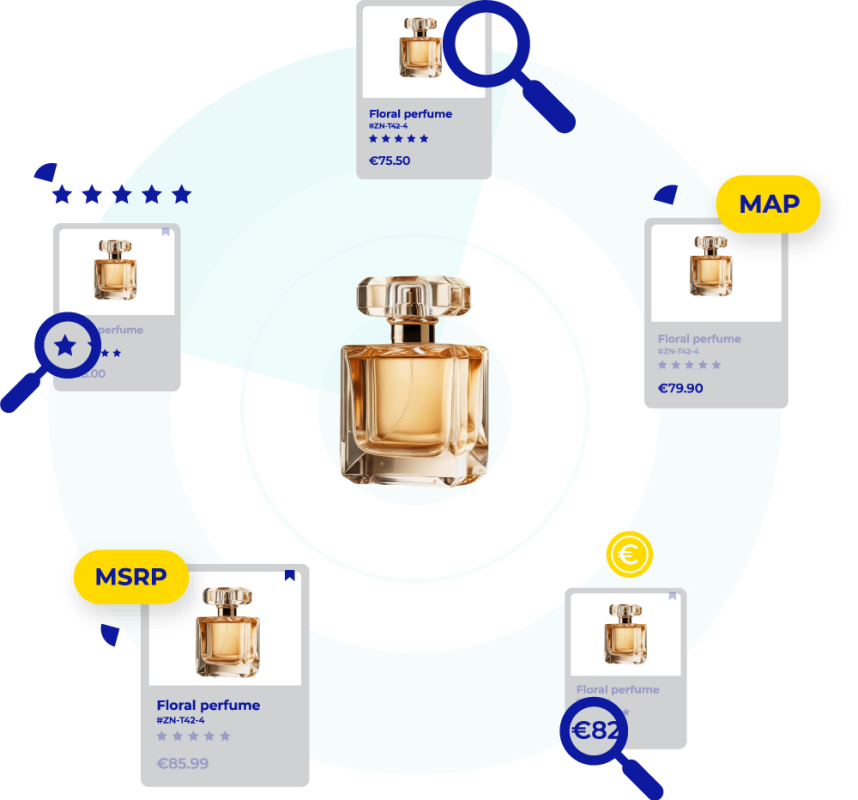
The Suggested Retail Price (SRP) is the price a manufacturer or brand recommends that retailers charge consumers for a product. While retailers are not legally required to follow it, SRP is a fundamental pricing reference used across industries – and monitoring it has become a critical priority for brands selling through multiple online channels.


What is the Suggested Retail Price (SRP)?

The Suggested Retail Price (SRP) is the price point that a manufacturer or distributor recommends for the sale of a product to end consumers. It is sometimes referred to as the Recommended Retail Price (RRP) in Europe and Australia, or the Manufacturer’s Suggested Retail Price (MSRP) in North America. These terms are largely interchangeable and refer to the same concept: a pricing guideline, not a legal obligation.

SRP gives retailers a starting point for setting their prices and helps manufacturers maintain consistent brand positioning across different sales channels. It is typically displayed on product packaging, in marketing materials, and on brand websites.


Why do manufacturers set an SRP?

Setting an SRP serves several strategic purposes for brands and manufacturers:

  • Brand positioning: A well-defined SRP communicates the perceived value of a product and helps anchor it in a specific market segment.
  • Channel harmony: When retailers price products consistently around the SRP, it prevents price conflicts between distribution partners.
  • Consumer clarity: A stable SRP makes it easier for consumers to recognize genuine promotions and evaluate whether a deal is real.
  • Margin protection: Retailers who follow the SRP protect their margins and avoid entering destructive price-cutting cycles.


How does SRP differ from MAP and RRP?

Brands often use several pricing reference points simultaneously. Here’s how they compare:

  • SRP / RRP (Suggested or Recommended Retail Price): A guideline price for selling to consumers. Retailers can deviate from it freely unless other contractual arrangements are in place.
  • MAP (Minimum Advertised Price): A contractual minimum below which a retailer agrees not to advertise a product. Unlike SRP, MAP is enforceable through distribution agreements and is commonly used to prevent race-to-the-bottom dynamics online.
  • MSRP (Manufacturer’s Suggested Retail Price): The North American equivalent of SRP/RRP. Learn more about MSRP.

In practice, brands often define all three to create a complete pricing framework: SRP sets the target, MAP sets the floor for advertising, and internal cost calculations define the absolute minimum sale price.


SRP compliance in e-commerce: why it’s harder than it looks

In traditional retail, brands had little visibility into actual shelf prices once products left the distribution chain. Online retail changed that, but also introduced new complexity:

  • Products are sold simultaneously on dozens of platforms (brand websites, marketplaces, retailer sites, comparison engines).
  • Prices change daily or even hourly in response to algorithms, promotions, and competitor moves.
  • Unauthorized third-party sellers and grey market operators frequently undercut the SRP without the brand’s knowledge.
  • A single retailer selling below SRP can trigger a chain reaction across the market.

Monitoring SRP compliance manually across all these touchpoints is neither scalable nor reliable. Brands need dedicated tools to stay in control.


How to monitor SRP effectively across online channels

A robust SRP monitoring strategy should cover the following:

  • Automated price tracking: Continuously crawl retailer and marketplace pages to capture actual selling prices and compare them against your SRP.
  • Real-time alerts: Be notified immediately when a deviation from SRP is detected, whether a retailer is selling too low or, in some cases, too high.
  • Seller identification: Detect unauthorized sellers who may be undercutting official retail partners without your knowledge.
  • Multi-country visibility: SRP can vary by market. Your monitoring solution must handle geographic segmentation to give an accurate picture.
  • Historical reporting: Understand price evolution over time to anticipate peak periods (Black Friday, seasonal sales) where SRP violations tend to spike.


Lengow NetMonitor: SRP monitoring at scale

NetMonitor by Lengow gives brands and manufacturers comprehensive visibility into how their products are priced online – across every channel, market, and seller type.

With NetMonitor, you can:

  • Track actual retail prices against your SRP across all online retailers and marketplaces
  • Receive automated alerts when deviations are detected
  • Monitor MAP price compliance in parallel with SRP tracking
  • Identify unauthorized or grey market sellers
  • Access historical pricing data and trend reports
  • Manage your monitoring across multiple countries from a single dashboard

Whether your products are distributed through a handful of partners or across an extensive network of retailers and marketplaces, NetMonitor helps you protect your pricing strategy and brand integrity.


SRP and pricing strategy: the bigger picture

SRP does not exist in isolation. It is one element of a broader pricing strategy that includes production costs, competitive positioning, and perceived customer value. Brands that rely on SRP alone – without monitoring how it is applied in the real market – are exposed to pricing erosion that can be difficult to reverse.

To learn more about the different pricing approaches available to brands and retailers, read our guide on pricing strategies.


Ready to protect your Suggested Retail Price online?

SRP compliance is not a one-time effort, it requires ongoing, automated monitoring across every channel where your products are sold. Lengow NetMonitor gives you the tools to stay ahead of violations, protect your retail partners, and maintain the pricing consistency your brand depends on.

Request a demo to discover how Lengow NetMonitor can support your SRP monitoring strategy.

3,600+ brands & distributors grow with us