How to optimise your multichannel strategy thanks to product feed management?

3 Major Pricing Strategies: A Short Guide
Cost-based, value-based or competition-based: most pricing decisions online end up falling into one of these three logics, whether a business names it that way or not. Knowing which one you're actually using, and why, makes it much easier to spot when your pricing strategy stops matching your margins, your customers, or your market.
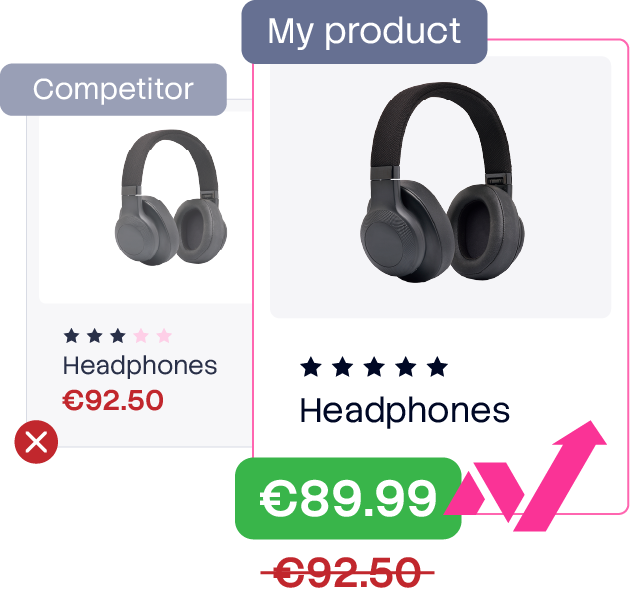
Table of content
Marketing process and price setting
Price setting is part of the marketing process and it requires an in-depth market research. The right price can generate more sales while the wrong one can make potential customers look elsewhere. Let's have a look at the most common pricing strategies.
In this short guide, we approach the three major and most common pricing strategies:
- Cost-Based Pricing
- Value-Based Pricing
- Competition-Based Pricing
1. Cost-based pricing strategies
Cost-based pricing strategies use production costs as their basis for pricing and, to this base cost, a profit level must be added in order to come up with the product price.
Cost-based pricing companies use their costs to find a price floor and a price ceiling, the minimum and maximum prices for a specific product or service, or the price range. The ideal thing to do would be setting a price in between the floor and the ceiling. Many companies mass-producing goods such as textiles, food and building materials use this pricing technique.
2. Value-based pricing strategies
Value-based pricing, also known as customer-based pricing, is a pricing concept defined as follows: the setting of a product's price based on the benefits it provides to consumers. In other words, it is about finding the price that your customers are willing to pay.
Companies using value-based pricing consider the value of their product and their customers' perceptions of value as the key to pricing. They determine how much money or value their product will generate for the customer, a value which translates into benefits such as increased efficiency, happiness or stability. By using this type of pricing technique, you may aim at using price to support product image, increase product sales and create product bundles in order to reduce inventory or to attract customers.
3. Competition-based pricing strategies
Competition-based pricing, also known as competitive pricing, consists in setting the price of a product based on what the competition is charging. This pricing method is normally used by businesses selling similar products, since services can vary from business to business, while the attributes of a product remain similar. In highly competitive markets, consumers judge products with similar features by the prices. Consequently, competitors may need to price their products lower or risk losing potential sales.
Keeping an eye on existing and emerging competition by using a competitor website price monitoring software will allow you to be more competitive. The more you know about your rivals and what they are doing, the better you can decide how to manage your prices.
It is important for companies to keep their production costs in mind, as well as managing the time they spend monitoring competitors and the prices set by them. With the expansion of e-commerce and Big Data, this last monitoring factor can be seen as a downside if it is not carried out properly.
Pros and cons at a glance
| Strategy | Pros | Cons |
|---|---|---|
| Cost-based |
|
|
| Value-based |
|
|
| Competition-based |
|
|
Boost your e-commerce performance with Lengow
Centralize, optimize and distribute your product catalogs across every sales channel.