
Guide
E-commerce for Brands
Price escalation is the increase in expenditure that occurs when a product is exported to a foreign market, because there are now export-related expenses such as tariffs, increased distribution costs, etc.
If you want to expand your commerce to international markets you must take into account the cost escalation as well as adapt to the regulations of the new countries in which you want to operate. If you want to expand within the EMU, you will have no obstacles. On the other hand, when acting in countries where there is no harmonization of laws you will have to take care of the cost escalation.
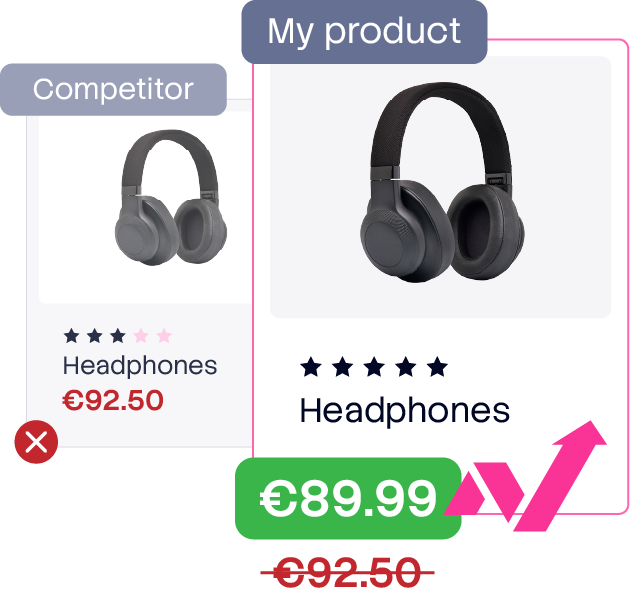
To avoid a price increase of your products, which would result in fewer profit, it is necessary to understand where you want to operate. You can monitor your competitors' foreign channels to observe their behavior and know what your position would be in the international market. Following your competitors manually can be a difficult task, so to track them efficiently, you have price monitoring tools at your disposal to compare your products with those of the competition automatically and periodically.
The information received through the price monitoring software will allow you to develop a strategy based on price intelligence, in other words, to assess the final impact on consumers' purchase decisions that cost escalation may have. This methodology will improve the performance of your business in foreign markets and increase the amount of goods sold.
This knowledge can also be applied to other aspects of your business, such as price renegotiation with suppliers or improving the efficiency of the distribution/storage channel of your products.
There are several levers to sell abroad without eroding your margins:
| Lever | How it works |
|---|---|
| Local manufacturing or sourcing | Manufacture in the destination country instead of exporting from your country of origin. A relief if your business has enough volume to justify it; if not, buying from local suppliers can be a suitable alternative. |
| Tariff reclassification | Reclassifying exported products under a different tariff category with lower duties. Valid but complicated: Cachaça manufacturers, for instance, have long pushed to be classified separately from rum in Europe and the US, where it's still treated as a rum variety. |
| Free trade zones | Producing and/or selling within a free trade zone. Check with your legal department whether your target export markets fall within an FTZ so you can save on some of the costs associated with exporting. |
To avoid reducing profits you will also have to take into account the inflation rate in the international markets you are going to operate in, as well as the foreign exchange rate. A product that in your original market may be perceived as mid-range, depending on which markets, can be considered a premium or high-end product.
Centralize, optimize and distribute your product catalogs across every sales channel.