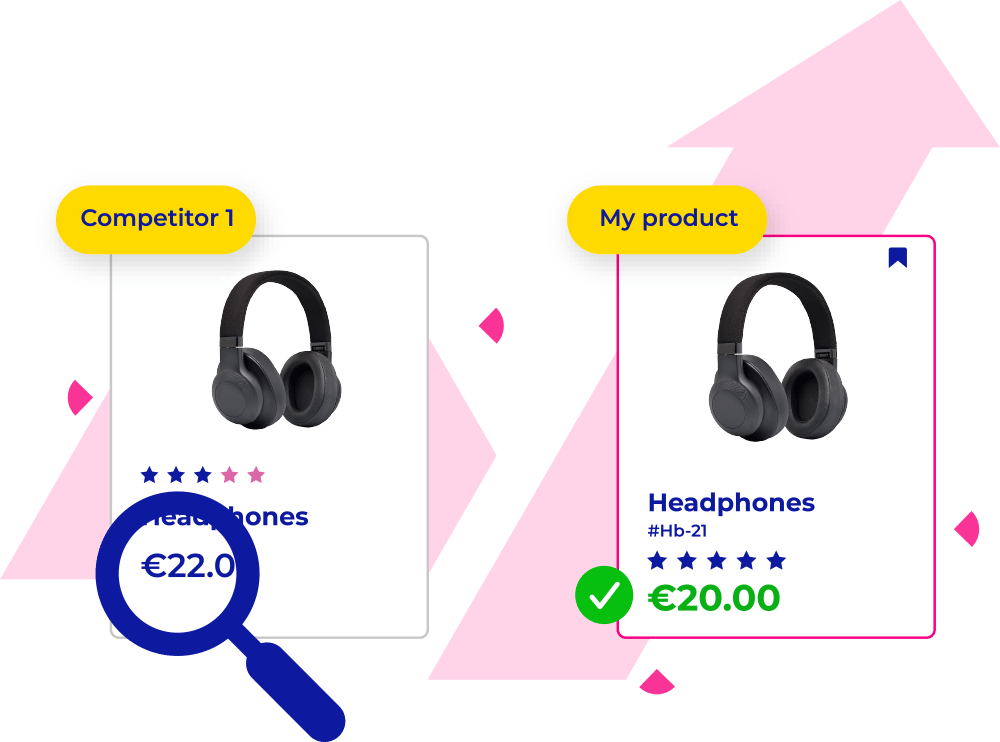
Same price, same product, different result depending on where you stand versus the competition. Here are the five ways to price against your rivals, and when each one actually works.
As the name suggests, competitor-based pricing is a pricing strategy in which a company sets the price for its products after observing the competition. Unlike cost-based or market-based pricing, it doesn't factor in your own costs, it only looks at what rivals are charging for the same or a very similar product.
To set a price this way, you first need to find the exact rival product you're pricing against, which means knowing your competitive landscape in detail. That's where competitor price monitoring software earns its keep: it can create automatic connections between products using their EAN code, so you're always comparing like for like instead of guessing.
Competitor-based pricing is one of the three basic pricing methods, alongside cost-based pricing and market-based pricing. Within it, there are really three directions you can take: match the competition, undercut it, or price above it. Here's how each works.
Parity pricing: matching the competition
Setting prices at the same level as the competition makes sense when the difference between your product and theirs is minimal or non-existent. It also fits markets or categories where products are conventionally priced the same way regardless of seller, bread or eggs, for example.
Underpricing the competition
Penetration pricing means entering the market significantly cheaper than the competition to win customers and build market share fast. It's a long-term play: once your business is established, you can raise prices again to grow your margin.
Discounted pricing is simpler, you just price consistently lower than the rest of the market. It works best for businesses with a large product catalogue or large-format physical retail, where volume compensates for thinner margins. Used carelessly, though, it's the fastest way to erode your profit margin, so keep a close eye on it.
Pricing above the competition
Premium pricing is a double-edged sword: price above your rivals and, over time, you can build a more prestigious brand and stronger margins. But shoppers can react badly to a higher price than they expect, and that will show up in your sales figures.
Price skimming sets a high initial price for a new product, then lowers it gradually to reach more price-sensitive segments of the market over time. It's most common in technology and video games, where early adopters pay a premium and the price comes down as the product matures.
Five strategies, three directions
Match: Parity pricing
Undercut: Penetration pricing, Discounted pricing
Outprice: Premium pricing, Price skimming
Track the market to price with confidence
Basing your pricing on the competition is a viable choice, but doing it well means monitoring the market at scale: average prices, how your catalogue maps against rivals', and their stock levels. That's a lot of data to track by hand, which is exactly why we built NetRivals, a solution that lets you track your competitors and set pricing strategies with a real understanding of the market.