How a Price intelligence solution can boost your ecommerce sales
What is Dynamic Pricing?
If you own an e-commerce business or are responsible for developing pricing strategies for the company you work at, you might have heard of dynamic pricing.
It has become a trend amongst retailers, and now brands as well, who want to have total control over their market share and improve their competitiveness online.
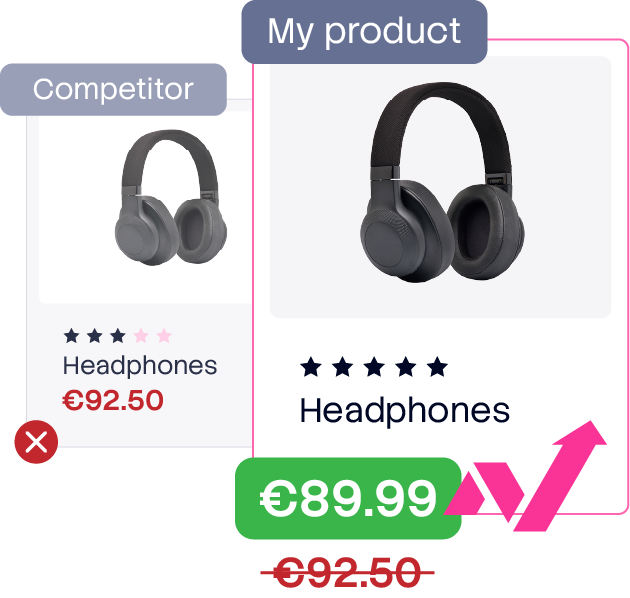
Table of content
Amazon is one of the online retailers and marketplaces e-businesses compete with the most: it changes prices on average every 10 minutes, offering very attractive prices to buyers. This online giant applies dynamic pricing strategies on a daily basis, but:
- What exactly is dynamic pricing?
- How does it work?
- And most importantly, why do online businesses need dynamic pricing solutions?
Defining dynamic pricing
Dynamic pricing is a pricing strategy that lets businesses set multiple price points according to different factors, such as time of year or customer demand. Unlike static pricing, it opens up more revenue generation instead of holding the same price level in every market situation and leaving revenue on the table.
In ecommerce, dynamic pricing is used to adapt product prices based on a set of predefined rules that respect your profit margin. This helps companies stay competitive and adjust their prices in line with the competition.
But how can an ecommerce business know which price to select for its products? This is where dynamic pricing solutions come into play.
How does a dynamic pricing solution work?
Many businesses still set prices manually, and they quickly see how time-consuming and costly it is to monitor prices one by one. Since prices change so fast and consumers are more demanding than ever, the way to lead the market is to use price intelligence software like our NetRivals solution, which browses the web and compares prices across 35,000+ websites.
A dynamic pricing solution suggests prices for your products according to several rules or parameters, and taking competitors' prices into account. To calculate the best price for each product, it factors in your acquisition price, the prices in your catalogue, the number of competitors for each product, and stock availability.
Thanks to this technology, you can set pricing rules that make sure you always offer the best prices while respecting your profit margin.
Say your goal is to always offer the lowest price to your customers: defining that pricing rule in our dynamic pricing solution might be the right choice for you. You can then decide which DTC websites, marketplaces and comparison sites to apply the rule on, making sure online users land on your listing and choose your product over your competitors'.
Dynamic pricing is a powerful problem-solver, but only when it runs on data-driven pricing software like ours, which ensures precise, real-time data.
Is dynamic pricing legal?
Although it may seem intrusive to have access to all of your competitors' product prices, what a pricing solution does is gather information that is publicly available on the web. As long as prices do not discriminate in any way, on the basis of gender, race or religion, for example, the fact that they change continuously thanks to technology is not illegal at all.
Why dynamic pricing is a "must" for your business
This pricing strategy is the key to saving time and money, and to increasing your ecommerce conversions overall. Here are the main benefits of integrating a dynamic pricing solution:
Boost your e-commerce performance with Lengow
Centralize, optimize and distribute your product catalogs across every sales channel.