What Does MSRP Mean?
What is an EAN number?
EAN barcodes are the longest-established and most widely-used of all GS1 barcodes. They are very important as they have changed the retail industry. Instantly recognizable EAN numbers are printed on almost every consumer product in the world and are visually represented by a combination of different numbers and dashes.

What does EAN mean?
EAN is the abbreviation of European Article Numbering, the product coding system used in barcodes. As its name suggests, it was originally used only in Europe, but it is now used all around the world, except for the US and Canada, where the 12-digit UPC is used instead. In practice, GS1 (the global standards body behind both systems) treats EAN and UPC as compatible subsets of the same broader family of identifiers, known as GTIN (Global Trade Item Number), which is why marketplaces and price comparison tools increasingly refer to "GTIN" as the umbrella term rather than EAN or UPC specifically.
What are EAN codes needed for?
The EAN number is a special and unique way to identify products in stock using a series of 13 numbers, though you can find 8-digit codes in some cases, if the product is small and the code would otherwise occupy 25% or more of the product's surface. Using an EAN number to identify a product brings several advantages:
- Increases the reliability of e-commerce by giving every product a single, unambiguous identifier.
- Optimizes inventory management and improves competitiveness easily and quickly.
- Helps sellers and consumers easily search and find the product worldwide without overlapping with unrelated listings.
- Minimizes human errors in product processing, such as typos, through automation and scanning.
- Lets sellers scan the item to identify it instantly, with no need to attach a separate price tag.
Why it matters beyond your own stock
EAN/GTIN is also the identifier most marketplaces and comparison engines use to match "the same product" across different sellers. Without a correct, consistent EAN, your listings can get mismatched with the wrong product page, or excluded from price comparison and catalogue-matching features entirely.
Structure of the EAN code
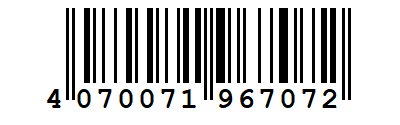
The code is divided into four blocks, each with a specific role in identifying the item:
| Block | Length | What it identifies |
|---|---|---|
| Country code | 2–3 digits | The GS1 member organization that issued the code, generally tied to the supplier's country of origin. |
| Manufacturer code | 4–5 digits | The specific company selling the product. |
| Product code | Remaining digits | The item's specific characteristics, such as its model or variant. See our guide on PIM for e-commerce for how this connects to broader product data management. |
| Check digit | 1 digit | A confirmation number, calculated from the other digits, used to verify the code was scanned or entered correctly. |
EAN vs UPC vs GTIN: what's the difference?
These three terms get used almost interchangeably, which causes real confusion for sellers listing on multiple marketplaces across regions. Here's the quick version:
| Term | Digits | Primarily used in |
|---|---|---|
| EAN | 13 (or 8 for small items) | Europe and most of the world |
| UPC | 12 | United States and Canada |
| GTIN | 8 to 14, depending on format | The umbrella standard: EAN and UPC are both types of GTIN, which is the term most marketplaces (Amazon, Google Shopping) now ask for in their catalogue fields. |
How is it possible to get an EAN code?
You can find many providers online, so there are plenty of options, but there is one condition to keep in mind: the provider must meet the GS1 standard, which is an internationally applied regulation. Once the request is processed, you will receive your barcodes and can insert them on your packaging.
If you are the manufacturer of the product, it is very important to have a barcode to identify each of your items, especially if you sell through a marketplace like Amazon, most of which require a valid GTIN/EAN at listing stage. As a whole, the EAN number makes e-commerce easier and more efficient, especially when it comes to automatically monitoring your products and the products of your competitors.
Make sure your EAN codes are working for you, not against you
Lengow NetMonitor tracks how your products, matched by EAN/GTIN, are actually priced and represented across every retailer and marketplace where they're sold.
Request a demo →