ChatGPT Product Feed (2026): specification for ChatGPT Shopping, Agentic Commerce
How to map products to every channel with AI
Lengow AI Category Mapping, part of the Lengow AI Studio, is built for brands and retailers that need to align large catalogues with many channels - both marketplaces and advertising platforms - without the manual workload. It analyses your product titles and descriptions and automatically suggests the best-fit category for each channel.
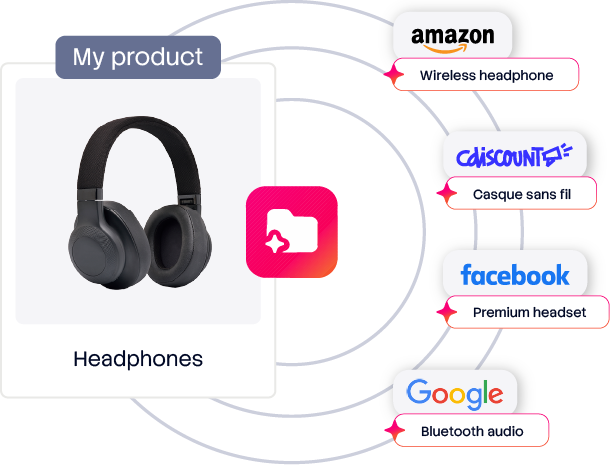
Table of content
Mapping your products to the right category on every channel - marketplaces and advertising platforms alike - is one of the most repetitive, error-prone steps in multi-channel e-commerce. Each channel has its own classification system, and a catalogue of thousands of SKUs has to be matched against all of them. AI now does this work for you: it reads your products, understands what they are, and suggests the best-fit category for each channel automatically. Here is how AI category mapping works, and why it changes the economics of selling across channels.
Can AI map my products to each channel's categories?
Yes - and it is one of the clearest examples of AI removing operational pain in e-commerce. Instead of a person browsing each channel's taxonomy and matching products by hand, AI analyses the product information you already have - title, description and key attributes - understands what the product actually is, and proposes the correct category for every marketplace and advertising channel you sell on.
The result is mapping that takes seconds instead of hours, stays consistent across your whole catalogue, and scales to as many channels as you want to add.
What is product category mapping?
Every marketplace and every advertising platform organises its catalogue using its own category tree. Amazon, Cdiscount and Zalando classify products one way; Google Shopping, Meta and other ad channels classify them another. Category mapping is the work of deciding, for each of your products, exactly where it belongs inside each of those structures.
It matters on both sides of the channel mix. On marketplaces, the category determines whether a listing is accepted, where it appears in search and browsing filters, and which attributes are required. On advertising channels, the product category (such as the Google product taxonomy) drives how your feed is interpreted, which queries your ads are eligible for, and how well your campaigns perform. Get the category wrong in either place and the product is effectively invisible.
Why mapping categories manually is so hard
On paper, assigning a product to a category seems trivial. In practice, doing it by hand across many channels is one of the most time-consuming jobs in publishing a catalogue.
The difficulty comes from several directions:
- No two channels share the same taxonomy. A pair of running shoes might sit under "Sports & Outdoors > Footwear" on one marketplace, "Fashion > Shoes > Athletic" on another, and a different node again in an ad platform's product taxonomy. Each new channel means starting over.
- Taxonomies are deep and constantly changing. Large channels have tens of thousands of categories and update them regularly, so a mapping that was correct last quarter quietly becomes outdated.
- Catalogues are large and dynamic. New products, seasonal collections and frequent assortment changes mean manual mapping is never finished.
- It depends on human interpretation. Different team members map the same product differently, creating inconsistency that is almost impossible to spot and fix at scale.
For brands and retailers expanding across borders, marketplaces and ad platforms, the problem compounds with every channel they add.
How AI category mapping works
This is where AI changes the underlying logic rather than just speeding up the same task. AI category mapping reads the information you already hold about a product - its title, description and attributes - and understands what the product genuinely is. It then matches that understanding against the full taxonomy of each target channel, marketplace or advertising platform, and suggests the most relevant category, automatically.
Because the AI works from the meaning of the product rather than rigid keyword rules, it handles ambiguous cases, large catalogues and unfamiliar channels far more consistently than a person scrolling through a category tree. Your team's role shifts from building the mapping to validating it - reviewing AI suggestions instead of starting from a blank screen. The channel's logic is performed for you; you simply confirm and publish.
The business impact of getting category mapping right
Accurate, AI-driven category mapping is not just an internal efficiency. It has a direct, measurable effect on commercial performance:
- Fewer rejected listings: Many marketplaces refuse products mapped to an invalid category. Correct mapping keeps listings live.
- Better discoverability: Products placed in the right category appear in the relevant search results, filters and ad queries, in front of shoppers with real purchase intent.
- Faster time to market: When mapping is no longer a manual bottleneck, every new channel launch and catalogue update ships sooner - and starts generating revenue sooner.
- Reclaimed team capacity: Hours spent searching channel taxonomies become hours spent on strategy and growth.
- Consistent catalogue logic: A single AI-driven approach classifies the same product the same way across channels, strengthening reporting and performance analysis.
Who benefits from AI category mapping?
Category mapping touches several roles, all of which gain from automating it:
- Channel and marketplace managers get products live faster and stop losing time to rejections and delayed launches.
- Feed and advertising managers ensure products are correctly classified for ad platforms, improving campaign eligibility and performance.
- Catalogue and product managers keep large, changing assortments consistently categorised without manual upkeep.
How Lengow AI Category Mapping helps you map at scale
- Eliminate manual mapping across complex marketplace and ad-channel taxonomies
- Reduce product rejections caused by category errors
- Improve search, filter and ad visibility on every channel
- Scale categorisation decisions consistently across your entire catalogue
Because AI Category Mapping runs inside the Lengow platform you already use to manage, optimise and distribute your feeds, there is no extra tool to learn and no switching back and forth. It is ideal for rapid catalogue onboarding, seamless channel expansion, and faster product launches at scale.
The impact is measurable. Brands using Lengow AI Category Mapping report 3x faster channel launches, 95% accurate mapping from the start, and an 80% reduction in manual mapping and correction time
- capacity that goes straight back into growing the business.
Ready to map your catalogue to every channel with AI?
Category mapping is no longer a task your team should be doing by hand. As your catalogue grows and your channel mix expands across marketplaces and advertising platforms, letting AI handle it is the difference between launching in days and launching in weeks - and between products that are found and products that are not.
Request a demo to see how Lengow AI Category Mapping can map your entire catalogue to every channel, automatically.
FAQ
Can’t find what you’re looking for?
Our guides
Guide
eBook
25/08/2026
1 min read
E-commerce for Brands
Guide
Webinar
25/08/2026
1 min read
The truth about Agentic Commerce
Guide
Case Study
29/07/2026
1 min read
Darty Case Study: Live on TikTok Shop in 40 Days
Guide
Case Study
29/07/2026
1 min read
Ufesa Case Study: Marketplace Sales Tripled in One Year
Boost your e-commerce performance with Lengow
Centralize, optimize and distribute your product catalogs across every sales channel.