

Google LIA (Local Inventory Ads): everything you need to know
Best for: retailers with physical store networks and structured inventory data looking to turn nearby Google searches into store visits by showing shoppers what is in stock, where, right now.
|
|
|
|
| Fast | Longer |
|
|
|
|
|
|
| Discovery | Purchase |
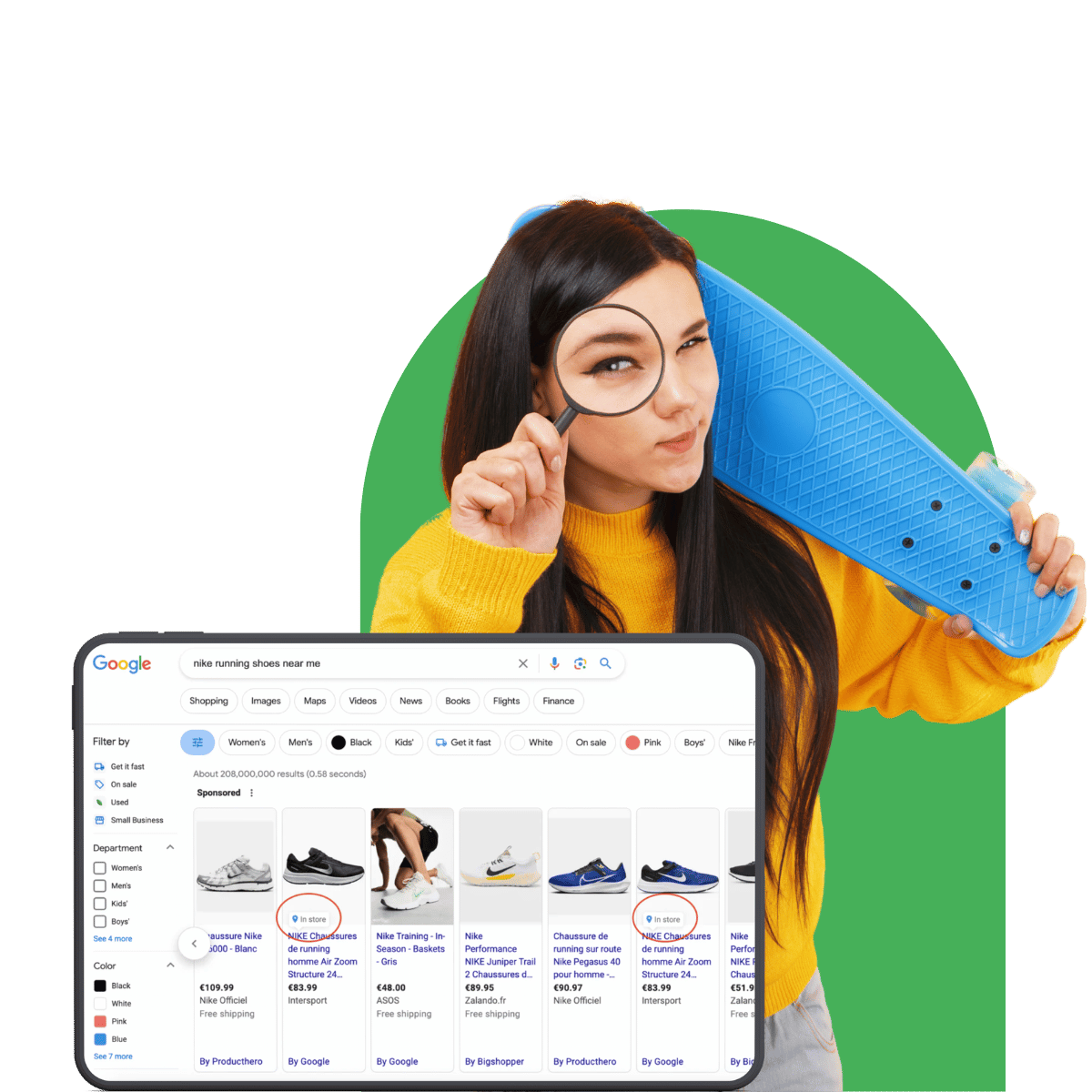
Google Local Inventory Ads (LIA) are Google’s web-to-store format. Shoppers searching near one of your stores see product ads showing that the item is available nearby; a click leads to a local storefront, hosted by Google or on your own site, with live stock levels, opening hours and directions. The mechanics are the same as Google Shopping: an auction, priced per click, driven by product data.
What changes is the data architecture. LIA runs on several interlocking feeds, a local products feed for the product sheets, a local product inventory feed carrying stock and price per store, and your Business Profile store locations, all matched by common IDs and store codes. An ad that promises in-store availability is a commitment: stale inventory data breaks it for a shopper who may be standing outside your door, which is why Google expects inventory updates at least daily.
Through Lengow, retailers manage both LIA feeds from one platform: category and attribute mapping, store-code handling, scheduled updates, and the reprocessing of per-store inventory files into the single consolidated feed Google expects. Google must approve your LIA eligibility, and on Merchant Center Next the Local inventory ads and Advanced data source management add-ons need activating before feeds flow.
Key figures
Sources: Google data and industry studies cited in Lengow’s Google LIA guide (2023, updated 2025); country availability per Google Merchant Center documentation and Lengow Help Center (updated October 2025).
Channel positioning
Who will see your ads?
LIA reaches shoppers with immediate, local purchase intent: people searching for a product while near one of your stores, often on mobile, often ready to buy the same day. The ad answers the one question that decides whether they come in: is it in stock here, now?
Checking availability before moving is now standard behaviour: 83% of online shoppers say they would visit a store if they could confirm the product is there first, and during peak season more than half check online before making the trip. A retailer whose inventory isn’t visible on Google simply doesn’t exist for these searches, whatever is actually on the shelf.
The discipline this audience demands is data freshness rather than bidding finesse: stock levels per store updated at least daily, accurate store codes, and prices that match what shoppers find at the till.
Sporting goods & apparel networks
Large-catalogue store networks where shoppers want to see, try or collect the same day, the profile of Decathlon Italy’s LIA programme.
DIY, home & garden
Project-driven purchases that can’t wait for delivery: shoppers check availability, then drive to the store that has the part today.
Electronics & appliances
High-value items shoppers research online and prefer to collect or inspect in person, with click & collect closing the loop.
A weaker fit: small store counts
LIA requires physical stores, so pure players are ineligible, and for one or two locations the multi-feed setup may outweigh the return compared with a well-maintained Business Profile.
Who runs Google LIA?
LIA sits at the junction of paid search and store operations, which shapes who owns it: search teams run the campaigns, but the programme only works when store inventory data flows reliably underneath.
SEM & SEA managers
Extend existing Shopping campaigns to local inventory and answer for cost per store visit alongside ROAS. They need clean segments and A/B-testable feeds to prove the channel’s impact.
Omnichannel & drive-to-store leads
Own store-traffic targets for the retail network. Their constraint is proving that digital spend moves footfall, which is exactly what LIA’s store-visit measurement exists to show.
E-commerce managers & store ops
Bridge the campaign side and the inventory side: per-store stock exports, store codes and update schedules. They need one platform where all the LIA feeds stay consistent.
What you need to know before launching
LIA is a Shopping campaign with a logistics problem attached. The auction side will feel familiar to anyone running Google Shopping; the work is in the feed architecture and the store data behind it.
Advertiser profile
Retailers with physical stores in an eligible country, a digital inventory system per store, a Merchant Center account, and Google’s approval of LIA eligibility.
Cost model & budget
Cost per click, in the same auction logic as Google Shopping. Budgets and bidding live in Google Ads; the store-visit conversion adds a cost-per-store-visit lens on top of ROAS.
Countries
Google offers LIA in 24 countries across Europe, the Americas and Asia-Pacific. In Lengow, the channel is added via France, the UK or Germany, and the same feeds serve every market where Google enables LIA.
Technical setup
Merchant Center linked to Google Ads, a Business Profile carrying every store location with its store code, and on Merchant Center Next, the Local inventory ads and Advanced data source management add-ons activated.
Feed requirements
Two feeds in Lengow: local products (the product sheets, updated at least weekly) and local product inventory (stock and price per store, updated at least daily). Your Business Profile locations feed runs outside Lengow, and an optional Google Shopping feed covers products also sold online.
Measurement
Store visits and cost per store visit sit alongside clicks and ROAS. A/B testing LIA against standard Shopping, as Decathlon Italy did, is the clean way to prove incremental impact.
How to advertise on Google LIA with Lengow
Advertising on LIA with Lengow starts from your Merchant Center, Google Ads and Business Profile accounts. Lengow then builds the two LIA feeds, links them through common IDs and store codes, and keeps them updated on the cadence Google expects, weekly for product sheets, daily or more for store inventory.
The channel rewards retailers who treat store inventory as marketing data. Lengow helps structure, consolidate and monitor LIA feeds from the same platform as your other channels. Check out Lengow’s detailed Google LIA guide.
| Channel challenge | What successful advertisers do | What Lengow automates |
|---|---|---|
| Multi-feed architecture | Keep local products, local inventory and Business Profile locations consistent, matched by common IDs. | Both LIA feeds are managed in one platform, structured to Google’s matching logic. |
| Per-store inventory files | Consolidate one inventory export per shop into the single feed Google expects. | Reprocessing merges per-store inventory catalogues into one Local Product Inventory feed. |
| Store codes | Map each Google store ID correctly so stock displays on the right local storefront. | Attribute mapping and rules carry store codes through the inventory feed. |
| Update cadence | Refresh product sheets weekly and store inventory at least daily, more during peaks. | Scheduled feed generation keeps each feed on its own update rhythm. |
| Category & attribute mapping | Map products into Google’s taxonomy with complete attributes, as for any Shopping feed. | AI Category Mapping and attribute mapping adapt catalogue data to Google’s requirements. |
| Catalogue selection | Push the products worth driving visits for, and exclude items with unreliable store stock. | Segments, filters and exclusions control exactly which products enter the LIA feeds. |
| Online and local alignment | Run the optional online feed alongside LIA so products sold on the website stay covered. | The Google Shopping feed is prepared through the same platform, sharing the same catalogue logic. |
| Price accuracy | Match ad prices to till prices per store, and stay competitive in an ad unit that displays price. | Netrivals provides competitive price intelligence alongside per-store price handling in the feed. |
| Error monitoring | Catch disapprovals and matching failures quickly, since unmatched products show no local ad. | Channel reports surface feed errors before they cost local visibility. |
| Proving incrementality | A/B test LIA against standard Shopping campaigns and track cost per store visit. | Segments and MyCustomChannel support test structures and internal reporting. |
With Lengow AI Studio, AI is embedded directly into the feed workflow: AI Category Mapping classifies products into Google’s taxonomy faster, AI Content Localisation adapts product content per market, and AI Image Compliance prepares visuals for Merchant Center requirements at scale.
How Decathlon Italy made LIA pay for its stores
Decathlon Italy launched LIA through Lengow to drive web-to-store sales for its 140 physical stores, distributing 200,000 products across 16 channels and optimising a 3-million-product catalogue within four months. The results were A/B tested against standard campaigns, run by the SEM team.
Store inventory turned into ad inventory: one consolidated feed for 140 stores, and local campaigns that cost less per visit than before.
Read the Decathlon Italy success story
Powering industry leaders
Discover more advertising channels





Take control of your advertising performance
Join thousands of brands and retailers using Lengow to structure, optimise and distribute their product feeds across every advertising channel, with data-driven insights and full control.


