Top Marketplaces in Germany (2026)
Top Marketplaces in the EU (2026)
The European Union is one of the world's largest and most dynamic e-commerce markets, bringing together 27 member states, over 450 million consumers and a rapidly evolving digital retail landscape. According to Cross-Border Commerce Europe, the European cross-border e-commerce market reached €358.7 billion in 2024/2025, with online marketplaces driving 70% of that total, equivalent to €247.5 billion in GMV. Whether you are a brand looking for scale, a retailer seeking new channels, or a distributor expanding across borders, understanding which EU marketplaces to prioritise in 2026 is a strategic necessity. This guide covers the top platforms operating across EU member states, how they differ, and how to connect your catalogue to them efficiently via Lengow.
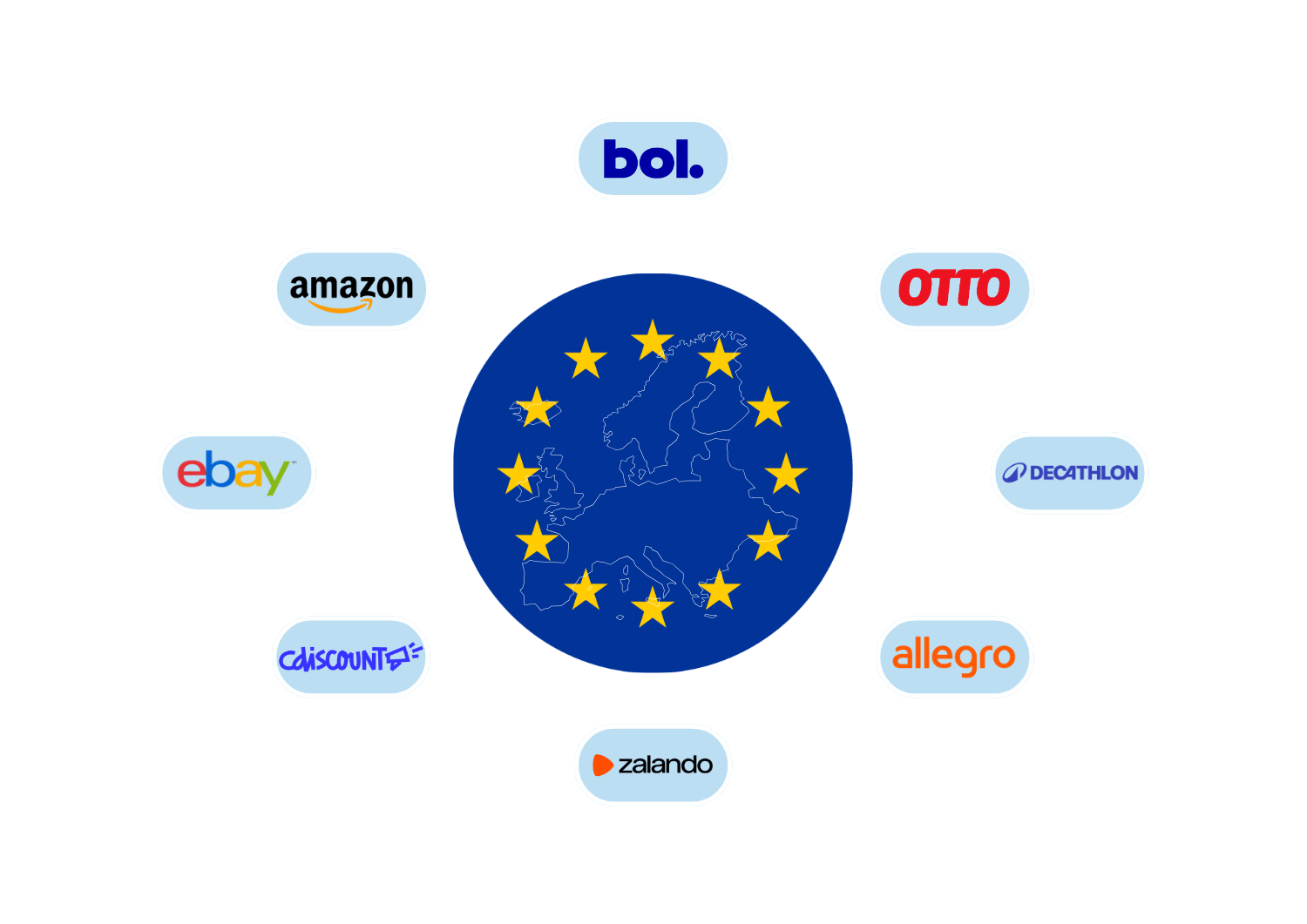
Table of content
The EU marketplace landscape at a glance
- Market scale: EU cross-border e-commerce reached €358.7 billion in 2024/2025, up 10% year-on-year, with 70% generated through online marketplaces (Cross-Border Commerce Europe).
- Top 5 EU markets: Germany, France, Italy, Spain and the Netherlands together generate the majority of EU e-commerce revenue, and all five are served by the continent's leading marketplace platforms.
- Market leaders: Amazon and eBay together capture more than half of all marketplace-driven turnover in Europe; the top 100 cross-border marketplaces generated €216.82 billion in GMV in 2024/2025, a 10% year-on-year increase (CEP Research).
- EU-native powerhouses: several of Europe's most successful marketplaces are born in the EU itself, from Zalando (Germany) and Allegro (Poland) to Vinted (Lithuania) and ManoMano (France), demonstrating the bloc's capacity to produce globally competitive digital platforms. 2025 was a genuinely strong year for most of them: Vinted's GMV grew 47%, Allegro's international marketplaces grew 60%, and Decathlon's marketplace volume grew 49%.
- Regulatory framework: the EU's Digital Services Act (DSA), GDPR and emerging AI regulations are setting global standards for marketplace transparency, seller accountability and consumer protection, making EU market entry more complex but also more trustworthy for buyers.
Top marketplaces in the EU (2026)
1) Amazon
Amazon is by far the dominant marketplace in the EU, with a presence in Germany, France, Italy, Spain, the Netherlands, Poland, Sweden and Belgium. Amazon closed full-year 2025 with $716.9 billion in total net sales, up 12% year over year, and third-party sellers accounted for a record 61% of all paid units sold globally (EcommerceBytes, via Amazon Q4 2025 results). In every one of the five largest EU e-commerce markets, Amazon holds the position of number-one or number-two marketplace by traffic and GMV. Its Pan-European FBA network allows sellers to serve all major EU markets from a single inventory pool, and its Amazon Business channel adds a powerful B2B dimension targeting EU procurement buyers.
- Suits: virtually all product categories; especially strong for electronics, home, garden, sports, fashion and FMCG.
- Notes: VAT OSS compliance is critical for EU sales via Amazon; Pan-European FBA simplifies cross-border logistics but requires careful inventory planning across multiple fulfilment centres.
Connect via Lengow: Sell on Amazon with Lengow.
2) eBay
eBay is the EU's second-largest generalist marketplace, with deep roots in Germany, France, Italy and Spain. For full-year 2025, the platform reported global GMV of $79.6 billion, up 7%, and revenue of $11.1 billion, with 135 million active buyers worldwide (eBay FY2025 results). Recommerce and C2C categories now exceed 40% of platform GMV, and eBay is actively doubling down on that positioning: it acquired the Nordic C2C marketplace Tise in 2025 and announced the roughly $1.2 billion acquisition of Depop, expected to close in Q2 2026, extending its reach into younger, fashion-focused recommerce buyers. In Germany (the largest EU e-commerce market) eBay remains the second most visited marketplace after Amazon, and the platform's strength in pre-owned, refurbished and collectible goods makes it a go-to destination for circular economy sellers across the EU.
- Suits: new and second-hand goods; especially strong for electronics, fashion, collectibles, automotive parts and DIY tools.
- Notes: eBay's advertising tools (Promoted Listings) and cross-border trade features are well-adapted to EU seller needs; the platform's open catalogue model enables broad product listings without prior approval.
Connect via Lengow: Sell on eBay with Lengow.
3) Zalando
Zalando is Europe's undisputed number-one fashion and lifestyle marketplace, headquartered in Berlin. Following the July 2025 closing of its ABOUT YOU acquisition, Zalando's combined group revenue grew 16.8% to €12.3 billion for full-year 2025, with group GMV up 14.7% to €17.6 billion, both at the high end of guidance (Zalando FY2025 results). Active customers reached a new high of 62 million across 29 markets. Zalando is the fashion platform brands cannot ignore when targeting EU consumers, and its Partner Programme gives third-party sellers access to Zalando's logistics, marketing tools and data insights.
- Suits: fashion, footwear, accessories, beauty and lifestyle brands of all sizes.
- Notes: strong sustainability positioning is increasingly a selection criterion for Zalando; the platform's Zircle resale feature is growing fast and opening new opportunities for circular fashion brands.
Connect via Lengow: Sell on Zalando with Lengow.
4) Allegro
Allegro is the leading marketplace in Poland and the EU's most important regional e-commerce platform in Central and Eastern Europe. For full-year 2025, Allegro reported Group GMV nearing PLN 70 billion (up 9%), consolidated revenue of PLN 12 billion (up 11%), and adjusted EBITDA of PLN 3.5 billion (up over 15%), with group active buyers reaching 21 million, more than 15 million of them in Poland (Allegro FY2025 results). The standout figure is international expansion: Allegro's international marketplaces (Czech Republic, Slovakia, Hungary and beyond) grew GMV 60% year over year, with international active customers up 40% to 4.6 million, evidence that Allegro's Central European gateway strategy is working faster than the core Polish business. Originally an auction site founded in 1999, Allegro has evolved into a full-scale marketplace with fast logistics and a loyalty programme (Smart!).
- Suits: all product categories; especially electronics, home, fashion and FMCG targeting Polish and Central European consumers.
- Notes: Polish-language listings and PLN pricing are mandatory; local fulfilment partnerships are a strong competitive advantage on this platform.
Connect via Lengow: Sell on Allegro with Lengow.
5) Bol.com
Bol.com is the leading online marketplace in the Netherlands and Belgium, the two countries that form the EU's Benelux e-commerce powerhouse. Owned by Ahold Delhaize, the parent group's full-year 2025 online sales rose 11.2% to €10.27 billion (13.3% at constant exchange rates), with the growth explicitly credited to "strong performance at bol" alongside online grocery gains (Fruitnet, via Ahold Delhaize FY2025 results). In the Netherlands, bol.com consistently outranks Amazon.nl in traffic, thanks to its deep local logistics network, cultural alignment and strong reputation. With over 13 million active customers and approximately 50,000 sellers, it remains the most important single marketplace for reaching Dutch and Belgian consumers.
- Suits: all product categories; electronics, home, children's products, books, sports and garden are particularly strong.
- Notes: Dutch-language product data is essential; bol.com's Fulfilment by bol (FBB) logistics service dramatically improves delivery speed and visibility; local customer service expectations are high.
Connect via Lengow: Sell on Bol.com with Lengow.
6) OTTO
OTTO is Germany's second-largest online marketplace after Amazon, operated by the Otto Group. In its 2025/26 fiscal year, OTTO's marketplace GMV grew 6% to around €7.5 billion, revenue under IFRS grew 7% to €4.7 billion, and its active customer base climbed 4% to 12.6 million, again outperforming the broader German e-commerce market, which the industry body bevh estimated grew just 3.2% over the same period (Ecommerce News EU). The marketplace now counts around 6,100 partners and 19 million items, and OTTO plans to internationalise the marketplace itself by 2026, opening it to retailers from the Netherlands, Poland, Austria, France and Spain, not just German sellers reaching German buyers. Its audience skews towards quality-conscious German consumers, making it a premium alternative to Amazon for brands that want to avoid commoditisation.
- Suits: home & living, furniture, fashion, electronics and garden; well-suited for brands targeting quality-oriented German consumers aged 30-55.
- Notes: seller selection is curated; OTTO tends to favour established brands and distributors with reliable fulfilment; German-language content and DIN/CE compliance are requirements, though the planned international marketplace expansion may open new entry routes for non-German sellers.
Connect via Lengow: Sell on OTTO with Lengow.
7) Cdiscount
Cdiscount is France's second-largest e-commerce marketplace after Amazon, with a rapidly growing third-party seller ecosystem. As of Q3 2025, the platform's overall GMV grew 1%, a performance entirely driven by its marketplace channel, which saw its own GMV grow 5.5%; third-party marketplace sales now account for a record 69% of all product sales on the platform (Groupe Casino Q3 2025). Its Octopia technology also powers third-party seller programmes at other major French retailers, making it a hub for multi-channel distribution in France. For sellers targeting French consumers across home, electronics and leisure categories, Cdiscount is a strategic complement to Amazon.fr.
- Suits: home & hobby, electronics, leisure, sports, DIY and general consumer goods targeting French-speaking consumers.
- Notes: Cdiscount Pro is a dedicated B2B channel targeting SME buyers; the Octopia platform enables easy expansion onto connected banners such as Brico Dépôt.
Connect via Lengow: Sell on Cdiscount with Lengow.
8) Vinted
Founded in 2008 in Vilnius, Lithuania, Vinted has grown into Europe's largest C2C second-hand marketplace, now operating in over 22 European countries with more than 100 million members. For full-year 2025, Vinted's GMV grew 47% to €10.8 billion, up from €7.3 billion in 2024, with revenue up 38% to €1.1 billion (Vinted FY2025 results). Worth flagging honestly: profitability moved the other way, adjusted EBITDA fell 5% to €151 million and net profit dropped 19% to €62 million, as Vinted deliberately reinvested in growing the German market, expanding into new categories like sports and collectables, extending Vinted Go carrier services to Portugal and Spain, and launching a Vinted Pay wallet. Free cash flow, however, still rose 36% to €137 million, so the investment appears disciplined rather than a warning sign. A growing Vinted Pro offering also opens the platform to professional sellers meeting volume criteria across multiple EU countries.
- Suits: fashion, accessories, children's clothing, electronics and home goods sellers (both individual and professional) targeting the rapidly growing recommerce segment.
- Notes: EU-headquartered and fully aligned with circular economy values; Vinted's recommerce model benefits from the EU's right-to-repair and sustainability regulatory tailwinds; Vinted Pro requires meeting volume and category eligibility criteria per country.
9) ManoMano
ManoMano is Europe's leading marketplace for DIY, home improvement and garden products, headquartered in Paris and operating across France, Germany, Spain, Italy, Belgium and beyond. The company has raised over $730 million in funding to date, the highest of any native European B2B marketplace by total capital raised (Statista), though worth noting honestly that overall GMV has declined rather than grown recently, down to roughly €1.0 billion in 2024 from €1.243 billion in 2022, which the company attributes to post-COVID normalisation and softer European consumer spending on home improvement. The genuine bright spot is its dedicated ManoMano Pro channel for trade buyers, artisans, contractors and construction professionals, which already represents around 10% of French revenue with over €100 million in GMV and is growing faster than the consumer business.
- Suits: tools, hardware, electrical, plumbing, garden and building materials brands targeting both consumers and professional trade buyers.
- Notes: highly specific technical product data (compatibility, dimensions, certifications) is essential for strong conversion; ManoMano Pro is the fast-growing part of the business and where near-term momentum is concentrated.
Connect via Lengow: Sell on ManoMano with Lengow.
10) Decathlon
Decathlon is Europe's number-one sports retailer, and its marketplace is rapidly becoming a key digital channel across the EU. For full-year 2025, Decathlon Group posted revenue of €16.8 billion (up 4.0%) on a total GMV of €20.7 billion (up 7.1%), with EBITDA up 21% to €1.8 billion and net profit up 16% to €910 million (Decathlon FY2025 results). The standout number for sellers: marketplace volume grew 49% year over year, far outpacing the group's overall growth rate, as Decathlon extends third-party selling to more of its 82 markets and pushes digital to over 20% of sales in core markets like France. For brands in sports, outdoor and fitness, Decathlon's marketplace combines high brand trust, a vast loyal customer base (325 million people reached, targeting 1 billion by 2030) and strong EU-wide physical store infrastructure with genuinely fast-growing digital reach.
- Suits: sports equipment, outdoor gear, fitness accessories, cycling, running, hiking and water sports brands.
- Notes: sellers must align with Decathlon's sustainability commitments; technical product data and compliance with EU safety standards are key requirements for listing.
Connect via Lengow: Sell on Decathlon with Lengow.
Who should sell where in the EU?
- Pan-EU reach (all categories): Amazon, eBay.
- Fashion & lifestyle: Zalando.
- Central & Eastern Europe (Poland and beyond): Allegro, now growing fastest in its international markets.
- Netherlands & Belgium: Bol.com.
- Germany (quality-focused): OTTO, soon opening to sellers from other EU markets.
- France: Cdiscount, ManoMano.
- DIY, tools & home improvement (EU-wide): ManoMano, Amazon.
- Sports & outdoor: Decathlon, whose marketplace is currently the fastest-growing channel in this list.
- Second-hand & recommerce: Vinted, eBay (now expanding aggressively into this segment via Tise and Depop).
How to sell on EU marketplaces with Lengow
Lengow connects your product catalogue to all major EU marketplaces from a single feed management interface, removing the complexity of managing localised data, currency, tax rules and order flows across multiple countries.
- Native connectors: Amazon, eBay, Zalando, Allegro, Bol.com, OTTO, Cdiscount, ManoMano, Decathlon and many more are all available directly through Lengow.
- Localisation at scale: automatically adapt product titles, descriptions, attributes and categories for each marketplace's language, taxonomy and buyer expectations, across German, French, Dutch, Polish, Italian, Spanish and more.
- EU compliance: manage VAT OSS obligations, GPSR product safety requirements and DSA seller accountability requirements with structured product data and compliant feeds built into Lengow's workflows.
- Automation: rules-based repricing, stock synchronisation across all EU channels, and promotional feed rules reduce manual workload and keep your listings competitive in real time.
Our guides
Guide
Case Study
14/11/2025
1 min read
Singularu Case Study: x8 Marketplace Orders in 2 Years
Guide
Case Study
03/04/2025
1 min read
Star Srl Case Study: 30+ Marketplaces, 3,500+ Orders a Month
Guide
eBook
16/12/2024
1 min read
E-commerce for Brands
Guide
eBook
03/09/2025
1 min read
Success on Marketplaces
Guide
Marketplace Management
25/06/2025
1 min read
TikTok Shop Guide for Online Sellers
List everywhere, manage it once
AI-powered feed management, global price monitoring, and the analytics to connect them, all in one platform.